Emerson expands Bengaluru R&D hub by 50 percent with greater focus on AI-driven test engineering
The NI Software Centre of Excellence gains global product responsibility as Emerson expands its work across semiconductors, transportation, aerospace and defence.
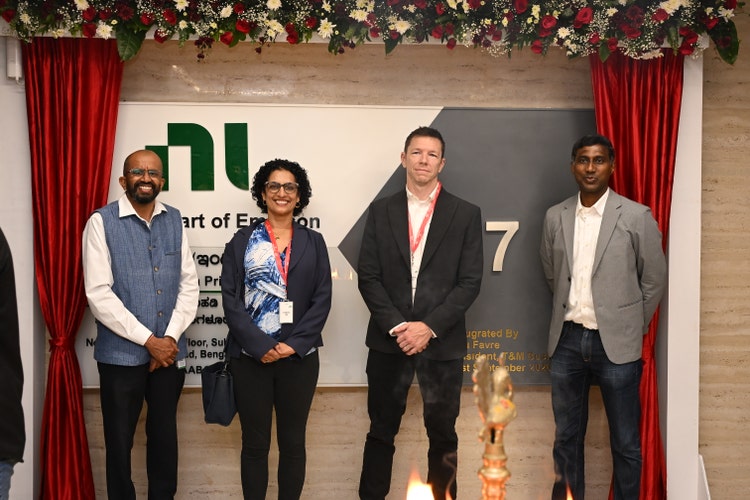
Emerson is expanding its Bengaluru test and measurement R&D facility by 50 percent, strengthening the site's role as a global innovation centre for AI-enabled engineering, test software, and validation technologies.
The company seeks to meet growing demand for sophisticated testing across semiconductors, electric mobility, aerospace, and defence while expanding the ecosystem of specialist partners needed to bring those technologies to customers.
The Bengaluru facility serves as Emerson's NI Software Centre of Excellence and is the company's second-largest test and measurement R&D centre worldwide. Engineering teams at the site develop software platforms, AI-enabled engineering capabilities, systems engineering technologies and RF test software used by customers globally.
Emerson said the expansion further advances the site's evolution from a global capability centre into a global test and measurement innovation centre with global product responsibility.
With products becoming software-defined and AI-enabled, testing and validation are becoming complex, creating demand for specialised partners that can combine engineering expertise with domain-specific capabilities.
In an earlier interview with CRN India, Luke Schreier, vice president of global sales, marketing and services for Emerson's test and measurement business, said the company remains open to working with partners across multiple engagement models as engineering AI adoption evolves.
He said Emerson is interested in working with value-added resellers, channel partners and IP partners as customers look for help solving increasingly complex engineering challenges.
"The industry is moving so fast. We want to approach that with as much engineering horsepower as we can bring together," Schreier told CRN India when discussing future AI-related opportunities around the company's NI software portfolio.
India's role expands beyond engineering execution
The Bengaluru expansion suggests that rather than functioning solely as engineering execution hubs, companies are assigning Indian operations responsibility for core products, platforms and innovation programmes.
Emerson's latest investment underscores that direction. The company said Bengaluru plays a strategic role in its global innovation network, developing technologies used by customers across semiconductor, transportation, aerospace and defence, life sciences, industrial manufacturing, research and academia.
According to Ritu Favre, president of Emerson's Test & Measurement business, the site combines expertise in test software and AI-enabled engineering with proximity to rapidly evolving industries.
The expansion is intended to help customers manage product complexity, streamline validation processes and accelerate time to market.
The investment also aligns with India's ambitions in semiconductor manufacturing, electric mobility and defence technology. Emerson specifically cited initiatives including the India Semiconductor Mission and the National Electric Mobility Mission Plan as factors increasing demand for advanced testing and validation capabilities.
AI changes the testing equation
A key theme running through Emerson's recent announcements is the growing use of AI inside engineering workflows.
At NI Days India 2026, Emerson introduced the next phase of NI Nigel AI, extending the platform from an AI assistant to an AI author capable of generating engineering code and test sequences directly within NI software.
The company said internal benchmarking showed the technology could reduce test development time and effort by up to 50 percent across representative engineering workflows.
The Bengaluru expansion will support further development of automated validation workflows, AI-enabled test engineering and integrated test and measurement platforms as organisations seek faster ways to validate increasingly complex products. Emerson said engineers are being asked to validate sophisticated systems within shorter development cycles, driving demand for more intelligent and software-defined approaches to testing.
Partners move closer to solution delivery
The expansion is likely to reinforce the role of partners in helping customers deploy and operationalise these technologies.
During previous conversations with CRN India, Emerson executives emphasised that customer requirements extend beyond standalone test systems.
The company has been building a broader ecosystem of distributors, alliance partners and system integrators that can combine test and measurement technologies with industry-specific expertise.
Priyachandar Paramasivam, country head and director of Emerson's test and measurement business in India, previously told CRN India that the company evaluates partners based on the skills customers require rather than through rigid partner classifications.
He said Emerson works with distributors, alliance partners, value-added resellers and system integrators across industries including semiconductors, transportation, aerospace and defence.
That ecosystem has continued to expand. Earlier this year, Emerson added Aimil Ltd. as an authorised distribution partner and strengthened collaboration with L&T Technology Services as part of efforts to broaden market reach and engineering capabilities in India.
Baskar Ceri, managing director of NI India, said at the time that the company relied on a large partner network to scale technology adoption across the country.
The company's strategy reflects a shift underway in engineering markets. As connected vehicles, semiconductor systems, industrial automation platforms and aerospace technologies become more software-driven, customers are looking for complete solutions rather than individual tools.
The expanded Bengaluru centre will develop many of the software and AI-enabled technologies powering those solutions.
For partners, the opportunity lies in combining those platforms with domain expertise, integration services and industry-specific intellectual property to help customers move from product design to validation and deployment.