Sarvam signs five-year MoU with Defence Ministry for AI projects across three Services
Framework covers the Army, Navy, Air Force and joint organisations under HQ IDS, with proposed applications in decision support, target acquisition and sensor-to-shooter data fusion.
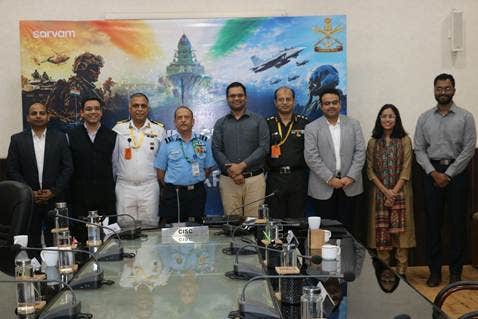
Sarvam has signed a five-year memorandum of understanding (MoU) with the Ministry of Defence’s Headquarters Integrated Defence Staff (HQ IDS) to develop and deploy artificial intelligence applications across the Indian Army, Navy and Air Force.
The framework covers operational, training and decision-support requirements across the three Services, as well as joint, tri-service and integrated organisations under HQ IDS.
Sarvam will design, develop and deploy AI applications under multiple projects and provide technical support, with HQ IDS facilitating engagement across the organisations.
The agreement establishes an umbrella framework for AI projects rather than announcing a single system or a completed deployment. The companies have not disclosed the MoU's value, the first projects to be undertaken, or a timeline for operational deployment.
The initiative aligns with the government’s push for Atmanirbharta in defence, extending the focus on indigenous capabilities to AI systems and infrastructure.
The release says the objective is to build an AI layer for the armed forces in India, using Indian data and compute and deploying capabilities on sovereign infrastructure.
The proposed work spans decision support, target acquisition and data fusion across the sensor-to-shooter loop. These applications are intended to support military operations by helping process and connect information from different sources.
The release also identifies geospatial and perception systems as part of the technology stack that will be made available under the framework. The three Services and joint organisations will have access to common foundation models and agentic infrastructure, alongside these systems.
According to Sarvam, the shared approach will allow doctrine and lessons learned from projects undertaken by one Service to inform work across the others.
This could support the development of common AI capabilities across the armed forces, although the release does not specify how individual applications will be integrated with existing military systems.
Human oversight will be retained over operational decisions, the announcement states. It does not detail the safeguards, validation processes or operating procedures that will govern the use of AI in target acquisition and other military applications.
The agreement also does not identify specific platforms, sensors or operational environments in which the applications will be deployed. Details on testing, performance benchmarks and the transition from development to operational use remain undisclosed.
Chanakya to lead the defence-focused work
Sarvam’s work under the MoU will be carried out by Chanakya, its firewalled division focused on national security and defence. Chanakya will apply Sarvam’s AI stack, including foundation models such as Sarvam 105B.
The company describes the initiative as part of its mission to develop AI capabilities in India for Indian requirements.
“Building that capability in India, on Indian data and Indian compute, is the need of the hour,” the release states, linking the agreement to the broader push for indigenous defence technology.
Pratyush Kumar, co-founder of Sarvam, said working with the three Services on national defence was an honour and a privilege. He also said the company was committed to delivering on the trust placed in it by HQ IDS.
The release does not disclose the compute infrastructure that will host the AI systems, the hardware suppliers involved or the security and accreditation requirements for deployment.
It also does not specify whether Sarvam’s models will be used in their existing form or adapted for particular defence applications.
The MoU further envisages an AI fabric connecting different elements of India’s defence capabilities. The details of this architecture, its implementation stages and the roles of any additional technology partners have not been announced.
The five-year framework sets out a route for Sarvam and HQ IDS to pursue AI projects across the three Services. Its impact will depend on the applications selected, their performance in military environments and how they are integrated into existing defence operations while retaining human oversight.