How NVIDIA is powering Sea’s five layer “AI kueh lapis”
Sea Limited is the first enterprise in the ASEAN region to adopt the NVIDIA Vera Rubin platform.
While Jensen Huang talks about the five-layer cake for AI, Sea Limited sees the support coming in for its version - a five-layer AI kueh lapis, which is a local delicacy in the region, featuring several different layers.
For Sea Limited, these five layers are the key areas in which their partnership with NVIDIA is also built upon. As the first enterprise in the ASEAN region to adopt the NVIDIA Vera Rubin platform, Sea Limited is focused on strengthening its AI capabilities to better serve and create meaningful economic opportunities for millions of consumers and small businesses across Southeast Asia.
According to Li Kuangli, Senior Director, Partnerships & Strategy at Sea Limited, the technology company has already deployed AI across its businesses to make its services more useful and accessible to its millions of users across its products and services globally.
With NVIDIA Vera Rubin, Sea will build on these efforts, developing and deploying AI models and intelligent agents at greater scale to serve the evolving needs of its communities.
“Sea will be the first enterprise in Southeast Asia to adopt NVIDIA's latest Vera Rubin platform. We're tremendously grateful for this decades-long and multi-faceted partnership with NVIDIA. We've been working very hard to put NVIDIA's chips to good use at every other layer of this Kueh Lapis,” Li said at the NVIDIA AI Day Singapore.
NVIDIA AI Day
The summit returns to Singapore after two years, with attendees having the opportunity at demo sessions to build AI agents using NVIDIA NemoClaw as well as taking part in the different sessions throughout the day.
As the only NVIDIA AI Day event in the region, NVIDIA continues to drive a strong focus in helping nations in Southeast Asia move AI from experimentation to production-scale deployment through open models, developer tools and a broad partner ecosystem.
Enterprises in Singapore are adopting NVIDIA Nemotron for various use cases. AI Singapore is expanding its SEA-LION model family to include the NVIDIA Nemotron open models and NVIDIA NeMo tools. SEA-LION is an open model family designed for Southeast Asian languages and cultures.
Beyond Singapore, similar work is already underway across the region. Malaysia’s YTL AI Labs is fine-tuning Nemotron models for enterprise and citizen services, while Viettel AI is doing the same for Vietnamese-language applications. In Thailand, the Big Data Institute and iApp Technology, as members of the ThaiLLM Collaboration, are exploring Nemotron as a foundation model.
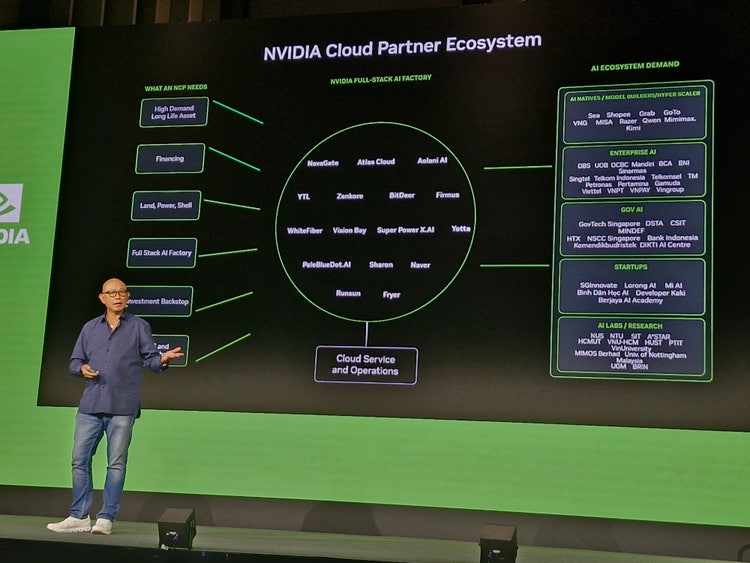
Raymond Teh, SVP, Asia Pacific at NVIDIA shared that what makes NVIDIA unique in this region is its strong cloud partner ecosystem as the vendor works with cloud service providers and operators from both the East and the West to provide customers with the full stack AI Factory.
Meanwhile, Marc Hamilton, VP, Solutions Architecture and Engineering at NVIDIA , sees the region’s strong growth, demand and also innovation in AI driving the era of useful AI, with more enterprises investing in the building and deploying AI use cases.
Sea’s AI Kueh Lapis
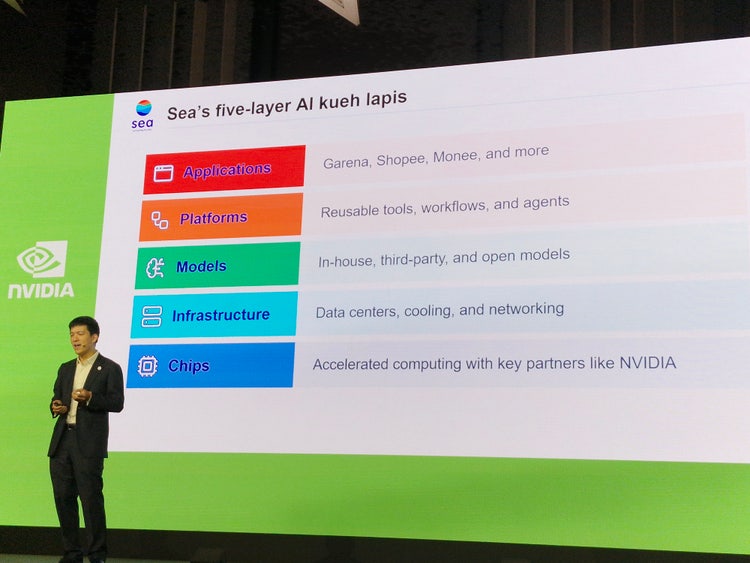
The five layers in Sea’s AI stack include applications, platforms, models, infrastructure and chips. Li explained that the first layer – applications are for the shopping, money and other business use cases. The platform layer is where the shared AI platforms help teams to turn models into useful agents and workflows, and then make those accessible in a repeatable, token-efficient, and well-governed way across the company.
Li said the models layer is where Sea pre-trains its custom models for the needs of its businesses while actively using third-party models and open models when they demonstrate practical value. Underneath that is the infrastructure layer, which Sea runs itself on all the data centers, including the servers, the networks, the cooling needed to run AI services reliably.
At the base are chips, including the GPUs that Sea sources from partners, such as NVIDIA, which are the workhorses to transform raw power into artificial intelligence.
“We do not produce our own AI chips but are fortunate to be able to call NVIDIA a specific partner in this. Our partnership did not start with AI. It actually started with a shared passion for the gaming community. We only started buying NVIDIA accelerators in 2018 for our budding machine learning R&D teams, and we've not looked back on AI since,” Li said.
“Sea has consistently invested in every generation of NVIDIA accelerators since Volta, and we were Southeast Asia's first NVIDIA DGX A100 customer. In 2021, we established Sea AI Lab, which has worked with counterparts in NVIDIA on joint AI research, technical exchange, and contributions to NVIDIA's open source ecosystem,” he added.
More recently, Li pointed out that Sea and NVIDIA both invested in two AI startups, WorldLabs and AMI Labs, which are doing groundbreaking work at the frontier of world models.
With Sea being the first enterprise in Southeast Asia to adopt NVIDIA's latest Vera Rubin platform, Li shared that Sea is tremendously grateful for this decades-long and multi-faceted partnership with NVIDIA.
“We've been working very hard to put NVIDIA's chips to good use at every other layer of this Kueh Lapis. The infrastructure layer has been a decades-long journey for the company. Sea's in-house infrastructure supports computing at a global scale, providing a resilient, cost-effective, and trusted digital backbone for Garena, Shopee, and Monee to operate on. We have more than 150,000 servers and 25,000 GPUs deployed across over 40 data centers worldwide, with a combined critical IT load of more than 100 megawatts,” he explained.
Li also highlighted that the in-house infrastructure interconnects with over 120 Tier 1 internet service providers, carrying more than 1.1 exabytes of traffic every month.
“Once we've secured the data center from our co-location partners, our in-house infrastructure teams can manage the full end-to-end infrastructure lifecycle, from design, to procurement, to deployment, testing, commissioning, operations, maintenance,” he said.
For Li, these foundations enables Sea to be a sophisticated user of AI technology, optimizing performance, responsiveness, reliability, and cost, down to the constituent hardware and the underlying AI factory infrastructure.
Sea’s AI use cases
On Shopee, AI is already helping sellers reduce the time and effort required to create informative product listings, improve product discovery and deepen customer engagement, while enabling better-informed business decisions. These capabilities enable small- and medium-sized enterprises in Southeast Asia, many of which operate with limited resources, to scale their businesses using enterprise-grade AI technologies previously accessible only to large corporations.
Across Monee, the digital financial services division of Sea, AI is being applied in areas such as fraud detection and credit risk assessment, supporting Monee’s ability to deliver simple, accessible and inclusive digital financial services. For small businesses and consumers underserved by traditional financial services, these capabilities can expansively broaden access to financial tools.
At Garena, Sea’s digital entertainment and video game arm, AI is used to enhance gaming experiences supporting the company’s efforts to create engaging, inclusive and safe online spaces that bring players together.
NVIDIA Vera Rubin will provide the advanced computing infrastructure to build on this foundation — enabling Sea to accelerate innovation, scale AI applications more broadly and deepen its impact for the communities it serves.
For Sea, Li said the company’s ambition is to turn this full-stack AI capability into sustainable value for the hundreds and millions of consumers and small businesses that it serves daily.
“The technology around AI is continuously changing. Building in-house capabilities across the stack, and then working with technology partners like NVIDIA gives us a strong foundation to keep innovating and improving on. Our mission remains the same to better the lives of consumers and small businesses with technology. Becoming AI Native is the next chapter in that mission,” he concluded.