Singapore businesses pull ahead in AI maturity as Microsoft pushes ‘frontier’ transformation
Judson Althoff, CEO of Microsoft Commercial Business believes Singapore is well positioned to translate its leadership in AI adoption into lasting economic and societal impact.
Singapore businesses are leading in AI strategy, maturity and execution. This was what the findings from IDC research commissioned by Microsoft revealed as businesses in the country look to the next steps in their AI journey.
Addressing the attendees at the Microsoft Frontier Tour summit in Singapore, Chia Wee Luen, Managing Director, Microsoft Singapore shared that the tech vendor remains committed to supporting businesses in the region.
“Microsoft's commitment to Singapore is comprehensive and forward-looking. We are investing in infrastructure and operational resiliency to the tune of US 5.5 billion dollars through to 2029. We are advancing knowledge…Our commitment to Singapore should ultimately not be measured by the number of dollars invested or the number of people trained, but by the people whose lives are made better and brighter because of the work that we do,” he said.
For Judson Althoff, CEO of Microsoft Commercial Business, Singapore is well positioned to translate its leadership in AI adoption into lasting economic and societal impact.
Taking a deeper look at the report, 17% of Singapore organizations are classified by IDC as Frontier Firms, with robust AI strategies that display higher levels of AI maturity and realize significantly higher returns on investment and superior business outcomes – as compared with 10% globally.
IDC identifies four priorities for Frontier Firms which are build for intelligence, operationalize trust and observability, advance agentic workflows, and measure and optimize value. Together, these priorities can help organizations move beyond isolated AI use cases and embed AI into workflows, decisions, and business outcomes across the enterprise.
According to Althoff, frontier transformation is a lot more different compared to AI transformation.
“It's different to AI transformation. It's different than any tech-led pursuit that we have ever seen in our industry because it requires that we put human ambition and business outcomes first. It's an opportunity to have a wholesale reinvention of how you think about your ideas coming to life, how you think about how your organization and your company can thrive in the industry that you operate in.”
“And so, it's super important that this not be some tech-led experimentation that is the next wave of technology implementation or implementing technology for technology's sake, but rather goal-seeking on the outcomes beginning with the end in mind and achieving more by each industry,” Althoff explained.
At the same time, nearly three in four Singapore organizations (73%) have reached the middle or highest levels of AI maturity, compared with 70% globally. For IDC, AI maturity is measured by an organization’s behaviors in spending discipline, breadth of use, agentic, adoption, skill , confidence to address AI risks and outcomes.
Singapore businesses are also seeing tangible results from AI, with 68% reporting significant or transformative outcomes that were not previously possible, while 41% say AI is growing revenue or creating new revenue streams.
The era of super intelligence
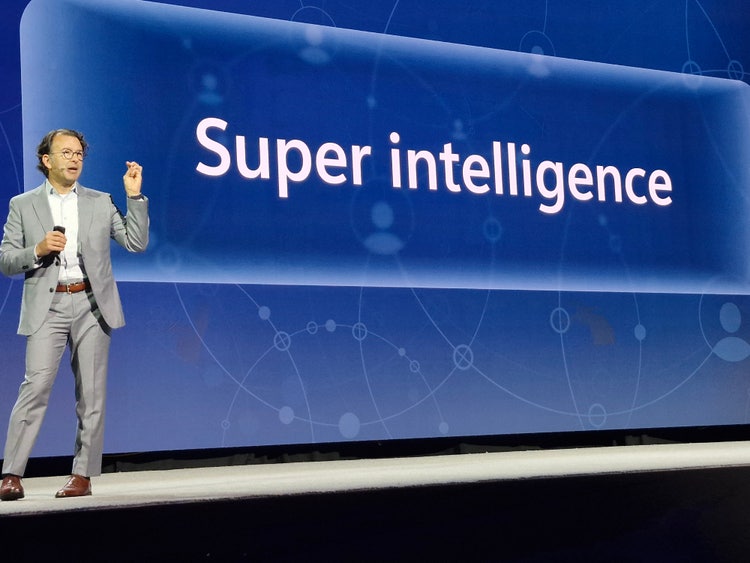
Another talking point during Althoff’s keynote was the notion of super intelligence which he acknowledged has been a hot topic, especially when there is increasing concerns on how AI is harnessed and ensuring that it is done right with trusted guardrails build around it.
“There's been a lot of rhetoric around super intelligence, certainly very lately, and I want to separate the hype from the reality of it and be super clear about one thing. There's no path where somehow this notion of infinite cognitive compute capability replaces human purpose. At the end of the day, harnessing intelligence, exploiting intelligence, commanding intelligence is a craft that humans will wield.”
For Althoff, there is a need to embrace this as an opportunity to achieve more in society.
“The path towards super intelligence will be a journey, and to be super clear, we are not there yet. We're not at a place yet where somehow there is this cognitive ability that can outpace human thought in every category. But, even if we do achieve that, on this path towards technology innovation and this accelerated path that we're all on, at the end of the day, it will not somehow change the purpose of humanity and the purpose of society, people's dreams and pursuits of health and safety and prosperity,” he added.
Althoff believes that super intelligence will simply be another tool that people use to achieve more and to reach their potential.
Looking at how Singapore can benefit from super intelligence, Althoff shared that there is a massive opportunity in the country whereby super intelligence can make a difference.
“What makes Singapore amazing is advanced manufacturing, this supply chain and the logistics hub of the world, a place where the rule of law matters, the governance around society really helps drive the best for the same. That's a place where AI can be harnessed, and this path towards super intelligence can do more for society. And we should be excited about it,” he said.