SoftBank and Grab plan US$1.85bn seed capital for AI infrastructure in Malaysia
The two companies and Sarawak’s PETROS plan to build AI infrastructure across Sarawak and Peninsular Malaysia, targeting five gigawatts or more of compute capacity, with funding released in stages against development and customer contract milestones.
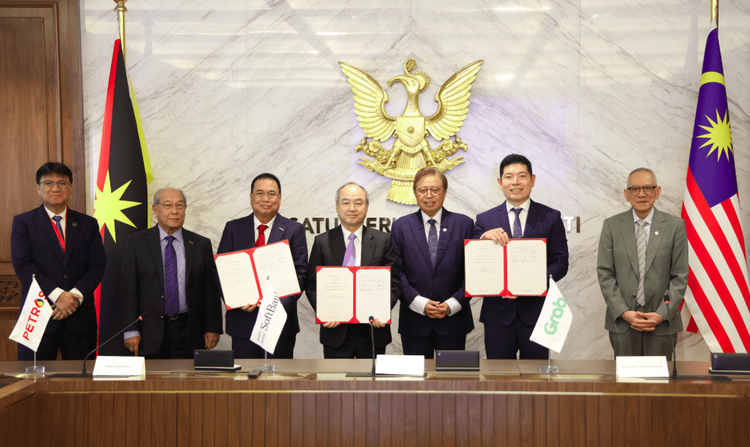
SoftBank Group and Grab Holdings have signed joint development agreements to build AI infrastructure in Malaysia, with plans for US$1.85 billion in initial combined seed capital alongside Petroleum Sarawak Berhad (PETROS).
SoftBank’s proposed share is US$1 billion, with US$750 million from Grab and US$100 million from PETROS, the companies said on 9 November. The money will be deployed in stages, subject to the projects meeting development and customer contract milestones and the necessary closing conditions.
The long-term goal is at least five gigawatts of AI compute capacity across Sarawak and Peninsular Malaysia under a multi-year plan. The partners will look for more investors and hyperscaler customers to support development and expansion. They expect the facilities, once fully operational, to rank among the largest AI infrastructure facilities of their kind in Asia, serving governments and businesses that need access to advanced computing.
Two projects, two lead shareholders
The Sarawak project will be developed jointly by all three parties and builds on a framework agreement signed in Kuching on 8 October. Its proposed initial investment is US$1 billion, with US$800 million from SoftBank and US$100 million each from Grab and PETROS. Grab has an option to increase its stake, which would reduce SoftBank’s share, although SoftBank would remain the majority shareholder.
The Peninsular Malaysia project has US$850 million in proposed seed capital, with US$650 million from Grab and US$200 million from SoftBank. As founding shareholder, Grab will lead its development and bring in long-term strategic investors as it scales. Further development is expected to be funded at the project level through third-party equity and non-recourse project financing.
Grab co-founder, chairman and CEO Anthony Tan is expected to oversee both projects and appoint dedicated management teams to run day-to-day operations, while continuing to lead Grab. Grab’s board has reviewed and approved his affiliation with the projects. SoftBank has also agreed in principle to a five-year lock-up on Grab shares held directly by an entity within SoftBank Group, subject to customary exceptions.
Demand for AI infrastructure in Malaysia and the region
Citing the e-Conomy SEA 2026 report by Google, Temasek and Bain & Company, Grab found that per capita AI usage across Southeast Asia’s six largest economies is around a tenth of the US level, and it projects that regional usage could grow up to 60-fold by 2030.
SoftBank chairman and CEO Masayoshi Son linked the investment to Malaysia’s potential role in that growth. “AI infrastructure will power the next wave of growth, and Malaysia has the talent and ambition to help lead it,” he said.
Tan said the infrastructure would help Grab speed up its work on localised AI for the region. “Together with SoftBank Group, we plan to build critical AI infrastructure in Malaysia, where Grab began, for all of Southeast Asia. This infrastructure will allow us to accelerate the development of localized AI solutions for our communities,” he said.
The projects will be developed in collaboration with the Federal Government and the Sarawak Government. They are aligned with the National AI Action Plan 2026–2030 (AI Nation 2030) and Sarawak’s Post COVID-19 Development Strategy 2030. The companies said the facilities will follow Malaysia’s renewable energy use guidelines and use high-efficiency designs intended to cut water use and reliance on local power grids.
The partners will also explore advanced manufacturing in Malaysia.