Vietnam’s MISA moves AI workloads in-house with NVIDIA infrastructure
MISA has built an on-premise AI infrastructure using NVIDIA DGX H200 systems to move more of its LLM and AI agent workloads in-house.
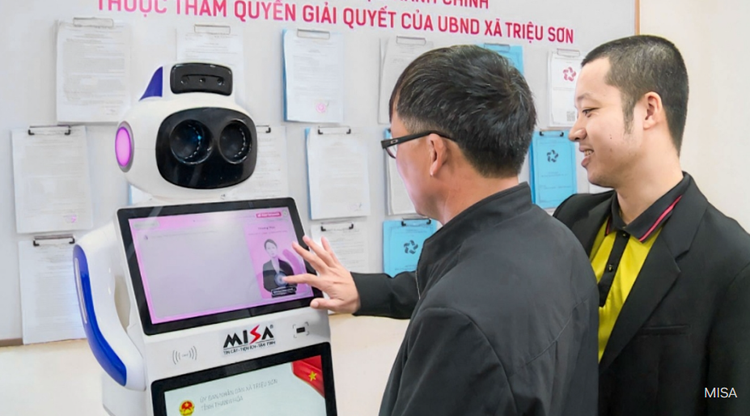
Vietnamese software company MISA has built an on-premise AI infrastructure using NVIDIA systems as it moves more of its generative AI and AI agent workloads in-house. The Vietnamese solutions provider provides SaaS and agent-as-a-service products used by more than 450,000 government and business customers. Its software covers accounting, tax, sales, human resources, and public administration workflows.
MISA had previously relied on external large language model APIs. According to the company, that setup created high operating costs, limited control over data security, and introduced latency for sensitive enterprise and public-service use cases.
The company's internal AI models include MISA AI 1.0, MISA AI 1.0 Plus, and MISA AI 2.0. These models are designed to support generative AI and AI agents within existing business and government workflows.
MISA deploys DGX H200 systems
MISA's on-premise AI cluster is built around eight NVIDIA DGX H200 systems connected through NVIDIA Quantum InfiniBand networking. The infrastructure supports both model training and inference, and is used to train and fine-tune models ranging from 8 billion to 235 billion parameters.
The company also runs its Core AI directly on the DGX cluster. Smaller, specialized workloads, including eKYC and router LLMs, are handled by NVIDIA A40 GPUs.
MISA uses NVIDIA Run to manage GPU resources through virtualization and fractional sharing. The company said this has increased the number of concurrent AI experiments from one or two to between 10 and 20 per week.
Its software stack includes NVIDIA AI Enterprise, NVIDIA NeMo, NVIDIA Dynamo, and NVIDIA NIM. NeMo is used for domain-specific fine-tuning, including Vietnamese-language and local administrative use cases.
The company said FP8 quantization has increased inference throughput from 1,200 to 4,500 tokens per second per model.
"NVIDIA's solutions not only enhance processing speed, system stability, and task-specific accuracy, but also establish a strong foundation for MISA to fully master the technology, including research, training, deployment, and security assurance, in order to deliver the best AI solutions to customers," said Nguyen Xuan Hoang, vice chairman of MISA.
MISA details AI agent use cases
MISA said the NVIDIA-based architecture has reduced fine-tuning time by four times and produced US$200,000 in monthly cost savings. The system supports more than 50 AI agents and processes 2.5 million daily feature usages.
The company has also developed more than 500 customizable AI agent templates. These cover areas such as retail sales, service scheduling, recruitment, and B2B consulting.
Among its deployed agents are MISA AVA for internal information retrieval, MISA AMIS OneAI for knowledge research and expert responses, MISA AMIS Support for customer assistance, MISA AVA Mail for email management, and MISA AVA Recruitment for hiring workflows.
MISA AVA is integrated into MISA AMIS, the company's business management platform. It is used in finance, accounting, sales, HR, and management workflows.
In finance and accounting, MISA said the assistant can automate invoice validation, reconciliation, and data entry. The company said financial documents and reports that previously took hours can now be generated within minutes.
In sales operations, the assistant provides product and pricing information, summarizes calls, helps draft emails, and extracts customer data. In recruitment, it handles CV intake, screening, evaluation, and data extraction.
For management teams, MISA AVA consolidates financial, sales, and HR data into reports and analytics. Users can request comparisons and trend information through natural language commands.
MISA said its AI capabilities are used by more than 450,000 organizations and handle more than 1.1 million LLM requests daily. The company also said its AI agents are being used by small businesses such as Noomfood for customer inquiries and order synchronization.
"At first, employees were concerned that AI might take over their jobs. However, once AI became a powerful support tool, the team gained more time to enhance their capabilities and take better control of the overall workflow," said Le Lan Phuoc, marketing manager at Noomfood.
Public services use AI assistants
MISA's AI systems are also being used in public administration settings. At the Public Administrative Service Center, an AI robot has been deployed to answer citizen queries when staff are occupied.
"The deployment of the AI robot at the Public Administrative Service Center is highly practical. When the staff at the counters are busy, we can ask the AI robot and receive answers very quickly. The interface is also very easy to understand," said Le Xuan Dung, a citizen from Thiet Cuong 2 Village.
MISA said it plans to continue developing AI agents for internal operations and external customers. Its roadmap includes image, voice, and 3D technologies, alongside further work on its LLM stack from pretraining to model optimization.