Alibaba Cloud expands Malaysia data centers to support AI adoption
Alibaba Cloud has opened its sixth data center in Malaysia and announced new AI collaborations with local businesses.
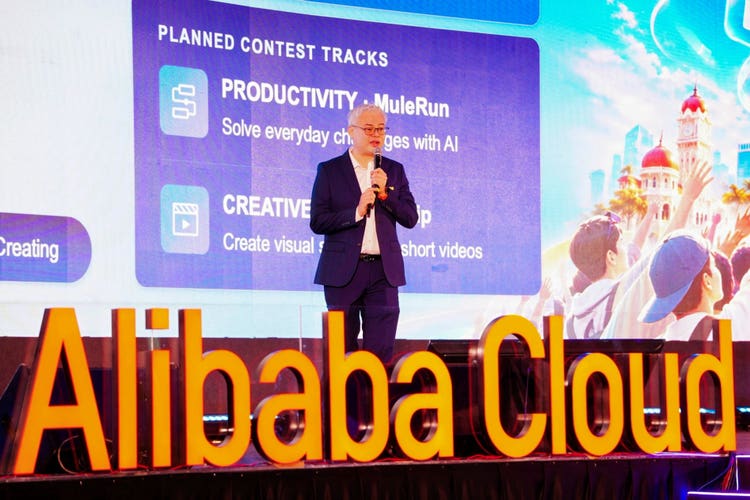
Alibaba Cloud has expanded its data center capacity in Malaysia and announced new AI collaborations with local organizations at Qwen Conference Malaysia 2026.
The company also presented its recently released Qwen4-Max AI model and launched a nationwide AI competition aimed at young Malaysians. Alibaba Cloud executives said regulatory compliance and the complexity of integrating AI into business processes remain challenges for Malaysian organizations.
Alibaba Cloud announced the availability of its third data center in Johor, bringing its total number of data centers in Malaysia to six. Johor became the company's second cloud region in Malaysia in June 2026, complementing its existing region in Kuala Lumpur, which houses three data centers.
The additional facility provides local capacity for businesses running cloud and AI workloads, including organizations with data residency requirements. The expansion forms part of Alibaba's previously announced US$53 billion investment in AI and cloud infrastructure.
Alibaba Cloud now operates 109 availability zones across 32 regions globally.
Choong Hon Keat, General Manager of Malaysia at Alibaba Cloud Intelligence, told CRN Asia that the company has built a services team in Malaysia to support regional customers. Malaysia was also the first country outside China where Alibaba Cloud established a telesales team serving the Southeast Asian market.
Choong said Malaysia remains one of the company's priority markets when evaluating new initiatives, although he did not confirm any plans to establish a dedicated AI research or resource center in the country.
Alibaba Cloud presented Qwen4-Max at the conference following its November 16 release. The model has 2.4 trillion total parameters, native vision capabilities, and a context window of up to one million tokens.
Alibaba said the model ranked sixth on the Code Arena coding leaderboard and recorded strong results in benchmarks covering agentic tasks, workplace productivity, and visual reasoning.
Supporting AI adoption across Malaysian industries
Alibaba Cloud also announced collaborations with several Malaysian organizations, covering telecommunications, energy, software development, and digital content creation.
CelcomDigi signed a memorandum of understanding (MoU) with Alibaba Cloud to explore API-based digital solutions combining cloud and connectivity services. The agreement also covers joint staff training and outreach activities.
In the energy sector, Alibaba Cloud is working with Cyberjaya-based AFED Digital, which develops AI-based software for upstream oil and gas operations. Its EDAFY platform applies AI to subsurface and field data, while its Dynectus platform provides enterprise resource planning capabilities.
AFED Digital uses Alibaba Cloud's infrastructure in Malaysia to develop and operate its applications, including their AI capabilities.
Meanwhile, DayDreamer Group is using Alibaba's Qwen and Wan models through Model Studio to support Theater, its AI video creation platform. The platform combines scriptwriting, translation, and video generation for applications such as advertisements and short dramas.
Alibaba Cloud is also working with AIGC Lab Malaysia, an AI-generated content community with more than 2,000 members. Under a signed MoU, both parties plan to explore workshops, educational content, and industry events to develop AI content creation skills.
Beyond these collaborations, Alibaba Cloud is supporting existing AI deployments, including TNG Digital's use of its Qoder coding tool.
Choong told CRN Asia that TNG Digital is using Qoder to support software development. He said Alibaba Cloud has received positive feedback from the company regarding the tool's productivity benefits, although no specific performance figures were provided.
He added that Alibaba Cloud works directly with customers to collect feedback and improve its tools, sometimes involving research and development teams from its headquarters.
Challenges in moving AI into production
While some Malaysian businesses have already deployed AI applications, others face longer adoption timelines due to regulatory requirements and the complexity of integrating AI into existing operations.
Choong said government agencies and financial institutions often require more time to evaluate AI deployments because of compliance obligations. Financial institutions, for example, must consider requirements set by Bank Negara Malaysia before implementing new technologies.
He said longer adoption timelines do not necessarily indicate a lack of interest in AI, as organizations must assess the business value of deployments while meeting regulatory requirements.
"Different customers and industries have different challenges when it comes to AI adoption," Choong said.
He added that Alibaba Cloud has also worked with technology companies that have adopted AI more quickly and implemented applications that deliver business value.
Lin En Shu, Head of Solutions Architect at Alibaba Cloud Intelligence, identified the complexity of integrating AI into existing business processes as another obstacle.
"The challenge is really to understand AI," Lin said, explaining that businesses need to identify which tasks can be delegated to the technology and where human oversight remains necessary.
He noted that content generation is relatively straightforward compared with agentic AI deployments, which involve assigning tasks previously performed by employees to AI systems.
Lin pointed to AI-generated advertisements in Malaysia as an example of an application that businesses have already adopted, while integrating AI into more complex workflows requires greater planning.
Data sovereignty also remains a consideration for organizations handling sensitive information. Choong said Alibaba Cloud offers public and private cloud deployment options based on customers' data classification and operational requirements.
He added that Alibaba's open-source AI models allow organizations to fine-tune and deploy AI within their own environments, including on-premises infrastructure
.