GlobalFoundries opens AI-enabled facilities control center in Singapore with Siemens
GlobalFoundries merges five fab-specific control rooms on its Singapore campus into one, ahead of a rollout across its global manufacturing network
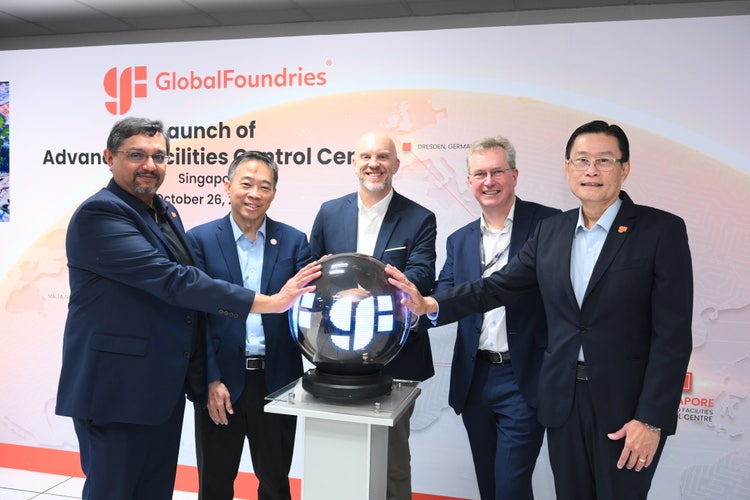
GlobalFoundries (GF) has opened an AI-enabled Advanced Facilities Control Centre (AFCC) at its Singapore site. The center was developed with Siemens to monitor facilities equipment and predict maintenance needs.
In its first phase, the AFCC brings five fab-specific control centers on the Singapore campus into a single command center, GF said. Singapore is the first deployment, and the company plans to extend the AFCC across the rest of its global manufacturing network.
The center combines facilities data and operational metrics with monitoring and visualization tools and AI capabilities such as predictive maintenance. According to GF, this lets teams spot emerging issues earlier and trace the root cause of a fault more quickly. Equipment health is monitored around the clock, which the company said would reduce unplanned downtime.
Pradip Singh, chief manufacturing officer at GF, said the center is meant to bring more consistency and visibility to facilities infrastructure across the company’s sites.
“Reliable facilities infrastructure is foundational to semiconductor manufacturing, and the AFCC represents an important step in building a more connected, intelligent and resilient global manufacturing network,” he said.
Robots and more than one million data points
Autonomous robots with thermal imaging, gas detection, vibration acoustics and other anomaly-sensing capabilities patrol the fab floor and campus and carry out routine visual inspections. They send real-time data back to the AFCC for analysis and response.
GF said that once the AFCC is deployed globally, it will integrate more than one million critical data points from facilities equipment across its manufacturing network. The company said this would let it benchmark operational metrics between sites. It added that running facilities from one center would reduce duplicated infrastructure, along with energy consumption and the associated emissions.
Isabel Chong, managing director of Digital Industries ASEAN at Siemens, said the project combines GF’s semiconductor manufacturing expertise with Siemens’ industrial digitalization capabilities.
“With trusted data, secure infrastructure and deep industrial know-how, we can scale predictive maintenance, advanced automation and Industrial AI with Singapore as the starting point,” she said.
Yew Kong Tan, senior vice president and general manager of APAC manufacturing and the Singapore site at GF, said the company’s digital foundation and support from the government and wider ecosystem made Singapore the ideal location for the first deployment. He also said the AFCC would change the work of GF’s facilities engineers.
“By equipping our facilities engineers with data and AI-driven capabilities, we are modernizing jobs and enabling our people to focus on higher-value diagnostics and problem-solving, deepen their technical expertise and build rewarding careers in semiconductors,” he said.
GlobalFoundries’ footprint in Singapore
Cindy Koh, executive vice president of the Singapore Economic Development Board (EDB), said the center gives local engineers a chance to deepen their digital capabilities. She also pointed to other areas EDB wants to develop with GF.
“We look forward to strengthening our long-standing partnership with GlobalFoundries and advancing new growth areas such as advanced packaging and silicon photonics,” she said.
GF has been expanding in Singapore for several years. In September 2023, it opened a US$4 billion expansion facility in the country. According to EDB, the facility added 450,000 300mm wafers a year and brought GF’s total Singapore capacity to about 1.5 million wafers annually at the time. In November 2025, GF acquired Singapore-based silicon photonics foundry Advanced Micro Foundry (AMF).
\