Cisco: AI threats are driving network and security convergence
Peter Bailey, SVP and GM, Cisco Security and Juan Huat Koo, Director, Cybersecurity, Cisco ASEAN discuss why network and cybersecurity should go together.
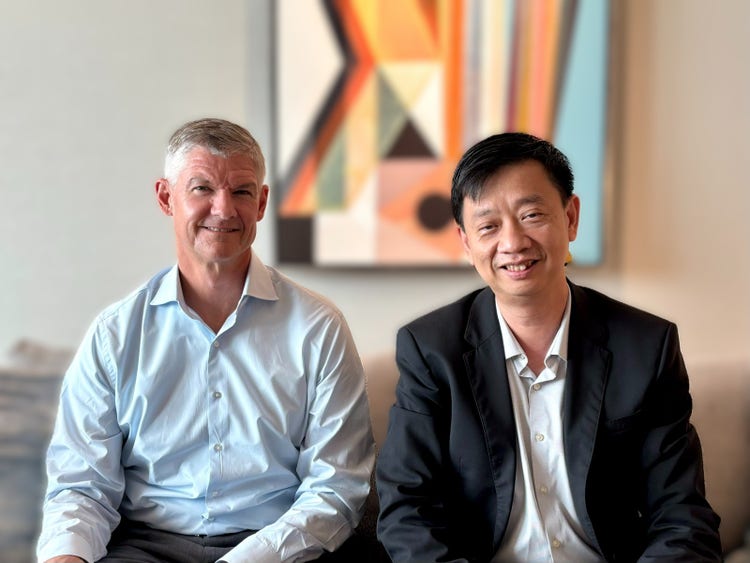
When it comes to network and cybersecurity, both Peter Bailey, SVP and GM, Cisco Security and Juan Huat Koo, Director, Cybersecurity, Cisco ASEAN believe that organizations need to look at opportunities to bring them together and not as a bolt-on or an afterthought attach.
In a conversation with CRN Asia, Bailey shared that the future of networking and cybersecurity will need highly integrated solutions that can operate at line speed.
“AI as a threat is a machine speed threat. It's not something that you can deploy a human policy at human speed and expect to block things. And so, we've got to have dynamic policy that can be enforced at line speed in the network. There's a unique opportunity by owning the network and security to provide very effective security,” he said.
Interestingly, Bailey also mentioned that while Cisco as an infrastructure company deeply believes that network and cybersecurity should go together, the vendor will still let their customers decide on the best approach.
“I think also on Cisco's best day, we provide really tightly integrated solutions for the customers that bring value by how well they work together. And so, in this era of AI, that's increasingly become important given the speed and the nature of these attacks,” he added.
Looking at customers in Southeast Asia, Koo pointed out that Cisco is working with some customers that are bound to have some assets that they just are not able to patch.
“They cannot install endpoints and so on, but they're part of the network. And how do you actually limit the movements laterally inside the network? It's going to be very key. That's why segmentation is a very important aspect of security. So, when we work with our customers, we ask them to take one step up and look at the whole challenge from a holistic perspective,” Koo said.
“Where possible, of course, you have endpoints, you get telemetry over there. But where not possible, if the systems cannot be installing endpoints or you cannot patch, there has got to be an architectural way to make sure that you're segmenting them and providing only the necessary access to all these critical systems,” he explained.
As the network sees all the traffic since everything is connected to it, Koo believes that the network is the best place to enforce security from that perspective.
“It carries all the way from the campus land to the wide area network to the data center to the cloud, because everything connects to the network. So, I also firmly believe that network and security have got to come hand in hand,” he said.
Helping customers deal with threats
For Bailey, there are basically two areas in which customers are concerned when it comes to threats today. First, it's all about the threats posed by malicious frontier AI threat actors. A lot of organizations are looking at how they can secure their environment.
The second area is on the use of AI, or shadow AI in particular. While more organizations have started using AI, they need to have the visibility of where their data is going, especially if there are employees that are using unsanctioned AI tools.
Looking at organizations in Southeast Asia, Koo shared that there are two types of customers. First, there are those that take a wait-and-see attitude. They may start with using some AI tools and then expanding into more use cases as the whole security maturity gets better.
On the other side of the fence, there are organizations that do not have no choice. They are competing against their competitors and are trying to adopt a more modernized kind of architecture approach with running AI.
“But regardless, there is this friction between the business and the IT security organization because the business is trying to push them to move faster, but they are also trying to secure the environment as well. So, when we speak with them, what we commonly discover is that visibility is one of the top concerns because they need to know where the agents are and what it's doing,” Koo said.
Koo explained if an organization does not know where its agents are and what its doing, they are not going to be able ensure that everything is going to be safe.
“So, we're doing a lot of work in that area to help them build that whole agent discovery portion all the way to accountability mapping and then enforcement,” he added.
AI is not the only threat
While AI-powered threats and the unsanctioned use of AI remain a concern for most organizations, Bailey pointed out that another concern for a lot of customers is their legacy infrastructure.
“Most customers are sitting on legacy infrastructure. They're sitting on products, and they're facing monthly or biweekly patches. And they're struggling to accomplish that. Because in the case of network infrastructure, maybe they would patch that annually. In the case of security infrastructure, maybe biannually, but certainly not every two weeks. And so, customers have to think about going from updating X number of systems per night to maybe even 100X to keep up with pace. This is by far the biggest challenge we're seeing, which, by the way, is a great opportunity for partners as well,” Bailey said.
Cisco sees partners helping customers build out automation and to provide the resources to help drive the modernization from a software and infrastructure perspective.
“On the infrastructure side, there's a lot of legacy beyond data support infrastructure out there that needs to be addressed. These are really the front lines of the post Mythos era. We've got to figure out how to change the operating model. Companies are working through that, and it's hard. They also need to update infrastructure that's at the edge and then ultimately look at vulnerabilities inside of the organizations and updating security controls and all of that,” he explained.
Bailey added that this is where there will a be a significant investment cycle, beginning with network upgrade and modernization as well as security upgrade and modernization, and then ultimately the emergence of new security controls that are going to secure modern AI.
Partnership with Ensign InfoSecurity and ST Engineering
For Koo, in this whole era of AI security, it's not a problem that Cisco alone can help customers solve.
“We've got to go along with our partners as well. It's got different capabilities.”
Koo highlighted two MOUs that Cisco signed at GovWare. The first is the partnership between Cisco and Singapore-headquartered Ensign InfoSecurity. Both companies are collaborating to strengthen enterprise security as organizations adopt AI at scale.
The partnership will see Ensign draw on Cisco’s Isovalent eBPF (Extended Berkeley Packet Filter) technology to deliver zero-trust for Kubernetes, complemented by Ensign’s capabilities to identify vulnerabilities and potential attack paths. The collaboration maps workload interactions in real time and enforces micro segmentation—halting lateral attack movement and containing compromised workloads or misbehaving AI agents directly at the source.
As part of the initiative, a dedicated proof-of-concept lab will be set up within Ensign’s lab, serving as a testing ground for real-world enterprise use cases and validate the operational value of these solutions.
The second partnership is between Cisco and ST Engineering. Both companies are collaborating to help Singapore enterprises strengthen their cyber resilience against AI-powered cyber threats. This includes jointly assisting enterprises to assess their security posture, co-develop resilient infrastructure services, and demonstrate end-to-end operational use cases across secure networking, IT infrastructure, cybersecurity, and application domains.
The new infrastructure services will integrate Cisco’s AI-era cyber defense strategies, assessments and technology solutions with ST Engineering’s latest cybersecurity solutions and AI-native cyber defense framework, enabling customers to fortify their defenses.
“Both these companies are heavily focused on pure play security. And the whole intent is to work together with them, join engagement with customers, to help them really address all these frontier AI threats coming their way,” he added.
Bailey added that the partnership with Ensign is also interesting as the company workjs with frontier and open source models to develop scanning for vulnerabilities and remediation capabilities.
“We have a very unique kind of playbook for doing compensating controls. It starts with segmentation, which is a huge opportunity. By the way, in the network, segmentation is probably our best defense against frontier AI attacks. Ultimately, air gap's better, but segmentation is obviously very effective. And most companies have not taken full advantage of that. So, it's a big services opportunity there,” Bailey said.
Bailey also highlighted Cisco’s unique Isovalent eBPF technologies that allow organizations to put shields in place and compensating controls that can shield specific vulnerabilities and attack vectors going after workloads.
“AI workloads is the new crown jewels that are being attacked. And so, we've been working for a long time with the frontier labs and helping secure their environments using the Isovalent technology as an example. The labs have all really standardized on eBPF. And we are probably the leader in eBPF globally, given the talent we have in our company through the acquisition of Isovalent. So that's an area that we are very heavily invested in,” Bailey added.
It’s all about the right security investment
While Cisco’s innovating tools in networking and cybersecurity can enable customers to be well protected, the cost of the technology remains a hurdle for some as well. Bailey acknowledged that Cisco has long been a high value, higher priced player
“We always try to guide customers that you get what you pay for. If you look at cybersecurity, especially new attack surfaces or new security paradigms, because these are so important and there's so much investment chasing them, we don't see ourselves in price wars too much. It's more about capability and innovation,” he said.
For Bailey, there's an opportunity to use AI from an operational perspective to dramatically simplify how security controls are deployed and reduce costs. He believes there's also other ways that actually gets less expensive for customers beyond the price of the solution.
“We firmly believe you get what you pay for. We're making the investments we need to make to provide tier one excellent security capabilities across our infrastructure and also the customers,” he added.
Koo echoed Bailey’s views and shared that a lot of customers are feeling the strain of buying a lot of best of breed silo products.
“It may seem cheap from a solution perspective. But when you put together in the security operations, it's actually not cheap. It becomes very difficult for them to actually train the skill set to be able to manage all these different products. And we're still trying to make sense of all these products coming together from a telemetry perspective,” he said.
With AI, the issue is getting even more urgent and prevalent. Hence, Koo believes that this is going to drive a massive amount of telemetry across the entire network.
“I think it's important for customers to really look at the platform approach to see how they can unify and consolidate their security use,” he added.
At the same time, while the platform approach is the way forward, Koo explained that there are very different ways of doing it.
“If you look at our competition, they will talk about platform from an endpoint perspective, firewall perspective, and a different perspective depending on where they start off. We want to look at it from a cross-domain, holistic perspective. And that's why we're unifying the network. We're unifying security workloads and things like that into a holistic architecture,” Koo added.
This is also where Bailey believes that Cisco’s offering of having the breadth and depth of network and security as a platform is a distinct advantage because AI can operate anywhere.
“You need visibility everywhere. You ultimately need enforcement everywhere. So, the extent you're trying to do that with a bunch of siloed security controls and different vendors at the network level just makes it much harder.”
“And so the ability to actually have that visibility to drive policy enforcement across all of that in an integrated stack is a distinct advantage, especially in AI. And the last thing I'll say is that because AI is obviously operating at machine speed, inline inspection and enforcement in particular is incredibly important,” Bailey concluded.