ESET executives outline AI cybersecurity investment at ESET World 2026
ESET announced a $40 million AI cybersecurity investment at ESET World 2026, including work on cybersecurity-trained AI foundations and ESET LiveCortex.
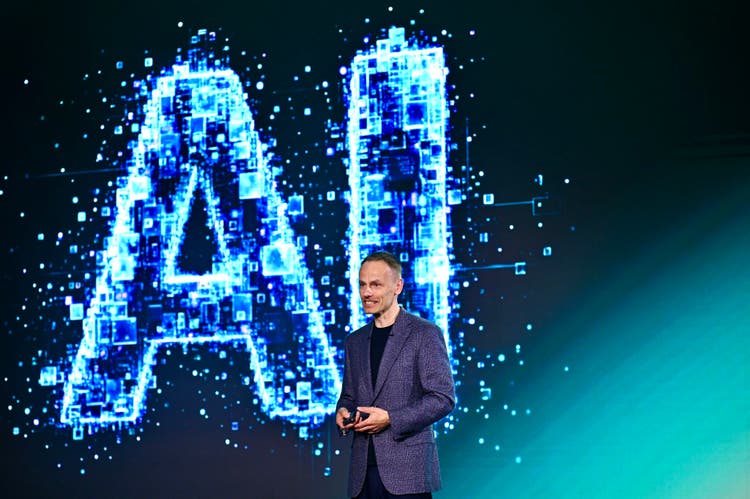
Richard Marko, Chief Executive Officer of ESET, said cybersecurity is entering a new phase as artificial intelligence becomes part of both enterprise systems and attack methods.
Speaking at ESET World 2026 in Berlin, Marko traced the development of cyber threats from early computer viruses to autonomous AI systems. He said the first computer viruses were often driven by curiosity but still caused disruption because they spread across systems and evolved quickly.
Marko compared the development of computer viruses and AI to biology. He noted that the term artificial intelligence was coined in the 1950s, with the human brain serving as the original inspiration.
AI changes the threat model
AI initially helped cybersecurity teams improve detection, according to Marko. He said heuristic methods and later deep learning helped ESET detect new malware more quickly and understand activity across the malware landscape.
That role has become more complex with the development of large language models. Marko said LLMs have enabled more convincing phishing emails, deepfake videos, and influence campaigns.
He cited Moldova's election as an example where AI was used to create TikTok accounts with realistic photos and biographies. He also said LLMs are now able to understand natural language and programming languages, which allows them to be used for coding tasks.
The keynote also covered the rise of autonomous AI systems. Marko described systems that combine LLMs, tools, and natural-language skills to perform tasks, test different approaches, and update their own procedures.
"What I am describing might sound a little bit like science fiction, but all the tools and all the mechanisms are already in place," Marko said.
Marko said this creates a broader challenge for cybersecurity. Organizations are no longer dealing only with malicious files or fixed attack methods, but also with systems that can import tools, use external skills, and adapt their behavior.
He said this also changes the nature of software supply chain risk. Systems that autonomously import new tools or skills can introduce risk without a person directly adding those components.
ESET invests in AI security
ESET announced a $40 million investment in AI-powered cybersecurity during the keynote. Marko said the investment will focus on three areas: AI foundations trained on cybersecurity data, new models for cybersecurity environments, and improved processing of security data.
"We believe that the future of cybersecurity cannot depend on models controlled by big tech," Marko said.
He said ESET is investing in its own AI foundations trained on cybersecurity data. He pointed to ESET LiveGrid as one example of a system already trained on cybersecurity data and used in operational detection.
Marko also discussed ESET LiveCortex, which he described as a system in its early stages. He said it is designed to correlate data from different sources and will be further developed through the new investment.
Security stack expands
Juraj Malcho, Chief Technology Officer at ESET, said the company's AI-related work covers shadow AI discovery, supply chain security, behavioral monitoring of skills, and conversational security. He said ESET joined the Agentic AI Foundation earlier this year and is working with other industry participants on open protocols, interoperability, and standards.
Malcho said AI is increasing the amount of data that needs to be stored, processed, and secured. "It is the same thing that we had in our data centers before, but it is more, it is faster," he said. He added that AI workloads are creating requirements around power, energy, compute systems, and security.
The company is also working on a layered AI security stack. According to Marko, this includes protection for communication between AI agents, browser-to-LLM interactions, and systems that use external tools or skills.
Malcho said ESET is also entering the network security field, using technology it has already deployed to secure its own infrastructure. The network probe includes deep packet inspection, aggregation, telemetry, and detection rules.
According to Malcho, the approach is designed to parallelize packet scanning and is about 20 times faster than the market average. He said ESET plans to add the network security stack to its private customer offering first, before making it more broadly available.
Marko said ESET's systems are currently receiving 750,000 new suspicious samples each day. He also said the company observed more than 60,000 OpenClaw skills in March 2025, including more than 10,000 considered suspicious and more than 1,000 classified as malicious.
Less than two months later, he said ESET was seeing more than 800,000 skills, including more than 25,000 suspicious and more than 3,000 malicious.
Human oversight remains central
Marko also addressed the role of human oversight. He said ESET surveys found ease of use ranked highly among customer priorities, while conclusions from AI agents ranked at the bottom.
"People really want to have the human touch," he said, adding that customers want to know there is a real human element behind cybersecurity systems.
ESET Private targets complex environments
ESET also announced plans to open new offices in France, the Netherlands, and India. Marko said the company protects more than one billion people directly and indirectly through partnerships, including about half a million business customers.
The company also introduced ESET Private, a lineup of corporate security solutions.
Martin Talian, Chief Corporate Solutions Officer at ESET, said the ESET Corporate Solutions division was established in 2022 to work with customers in mission-critical environments. He said these customers include government and defense organizations, critical infrastructure operators, fintech companies, banks, and transport and logistics organizations.
"They are not looking for the latest features or a beautiful user interface," Talian said. "They are looking for continuity, reliability, and stability of their operation."
Talian said Corporate Solutions has worked on deployments including security components for air-gapped defense infrastructure and a telecom-based system that checks URLs for child abuse and malicious content. He said the telecom deployment analyzes 5 million queries per second and more than 300 billion requests per day.
One example discussed by Marko was ESET Private Client Shield, which combines ESET technologies with a bank's online banking systems to help protect customers from scams.