‘Trust may cost more’: US cyber chief warns against cheap technology
“We cannot secure the world of tomorrow with the assumptions of yesterday,” says Sean Cairncross, National Cyber Director at The White House during his keynote address at SICW 2026.
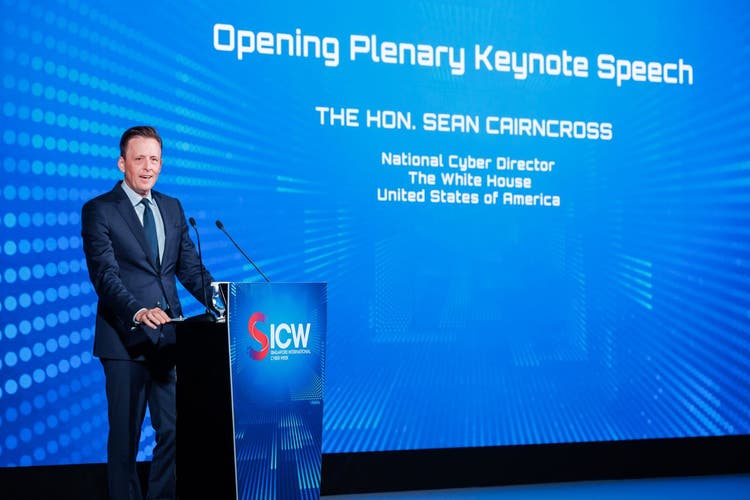
For Sean Cairncross, National Cyber Director at The White House, U.S, the rapid acceleration of digital technology is forcing governments and businesses to rethink how they approach cybersecurity, critical infrastructure and international cooperation, with traditional security models increasingly ill-suited to a hyper-connected world.
The keynote speaker at the Singapore International Cyber Week 2026 shared that cybersecurity can no longer be treated as a secondary consideration but instead become a fundamental requirement for countries and organizations seeking to take advantage of advances in AI and other frontier technologies.
“We cannot secure the world of tomorrow with the assumptions of yesterday,” Cairncross said, warning that bureaucratic structures created for a slower and less connected era were struggling to address the realities of geopolitical competition and increasingly sophisticated cyber threats.
With cybersecurity threats now transcending national borders, governments, organizations and their technology partners are having to deal with shared risks. This is why Cairncross believes that stronger cooperation between like-minded countries and the private sector is imperative, especially for companies that develop and operate much of the technology infrastructure underpinning modern economies.
“Trust is the indispensable foundation of this transformation,” Cairncross said.
Innovation and security must advance together
While Cairncross acknowledges the potential of emerging technology to improve healthcare and education, he stated that technological advancement must also be accompanied by stronger cyber defenses.
“Securing critical infrastructure and technologies is not, and must never become, an afterthought to innovation,” he said. “It is the very precondition that allows innovation to flourish.”
For Cairncross, cybersecurity should be a collective responsibility among governments, technology companies and international partners, particularly as state-backed groups and sophisticated cyber criminals increasingly have the potential to exploit interconnected infrastructure.
As such, he stated that digital sovereignty should therefore be measured partly by a country's ability to secure its networks, protect critical infrastructure and reduce potentially dangerous dependencies across technology supply chains.
Trust takes precedence over cost
Cairncross also made a clear message around technology procurement, warning governments and organizations against making purchasing decisions primarily on price.
“There's far more at stake than simply, what's the cheapest tech? Don't be asleep to the switch. It may cost more. Trust may cost more. But believe me, the long-term cost of the cheap stuff will show up, and it'll cost more,” he said.
The warning has implications beyond government cybersecurity strategies. Technology vendors, distributors, service providers and other partners increasingly sit within interconnected supply chains where weaknesses in one organization can potentially expose others.
Cairncross also said that real-time threat intelligence sharing between trusted partners is also an important component of this approach, allowing threats to be addressed before individual security incidents escalate into broader crises.
“The new cyber reality is not going to form itself. It must be shaped by those prepared to act with clarity, with speed, and with purpose. The United States is moving forward with clear eyes, and as always, we stand ready to move with our partners who are committed to doing the same,” he concluded.