Delta deepens NUS partnership to drive sustainable AI data center innovation
Delta will provide NUS CDE with an AI Containerized Data Center and related equipment, to support research and testing of data center technologies suited to tropical conditions.
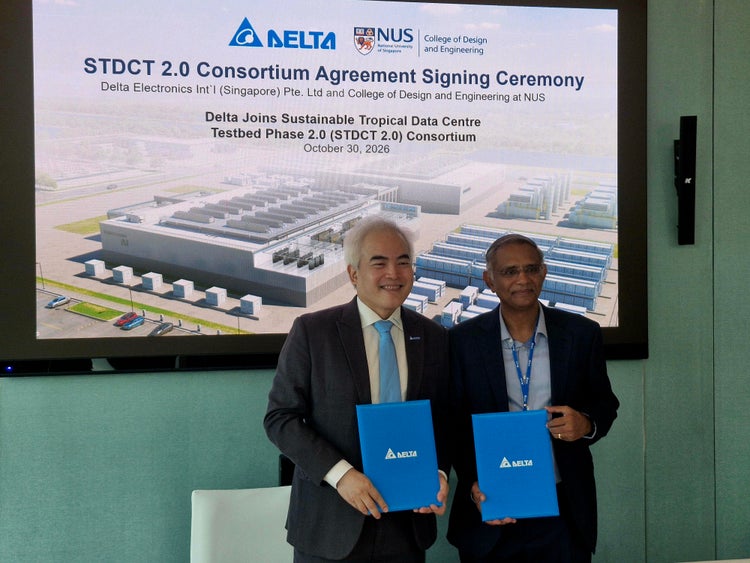
Delta Electronics has deepened its collaboration with the National University of Singapore (NUS) College of Design and Engineering (CDE) by joining the Sustainable Tropical Data Center Testbed (STDCT) Phase 2.0 Consortium to foster sustainable AI data center innovation.
The partnership which was signed during the Delta SEAO Future Industry Summit 2026 will see Delta provide NUS CDE with an AI Containerized Data Center and related equipment, to support research and testing of data center technologies suited to tropical conditions.
The power management and smart green solutions company hopes that its expertise in power, cooling, and data center infrastructure combined with NUS CDE’s research capabilities in tropical data center design and testing will enable more research on tropical data center design and testing.
Apart from the partnership, the summit brought together over 200 prominent government officials, industry executives and academics to discuss solutions that accelerate the adoption of sustainable digital and energy infrastructure.
According to said Jason Yuan, President of Delta Electronics Southeast Asia & Oceania, Southeast Asia’s infrastructure needs are evolving rapidly as AI and electrification reshape the region. With its long-term development in power and thermal management, Yuan shared that Delta brings deep expertise across power, cooling, automation and energy management.
“Our strength lies in bringing these capabilities together to help build future-ready infrastructure that is reliable, scalable, efficient and adaptable to the region’s needs. That is the conversation we want to advance by bringing our annual SEAO Summit to Singapore.”
Solving energy concerns
In her keynote address, Shan-Shan Guo, Delta’s Chief Brand Officer, said that as the energy transformation is accelerating fast, the demand for power is also growing rapidly as well.
Guo shared that the need for power is being driven by many verticals with AI seeing approximately 300% increase in power demand. Guo believes that this could lead to bottlenecks in power, with some nations already experiencing challenges.
“The challenge is about generating more power, and it is also beyond generating new power. It is about building a resilient, reliable, and efficient grid system. And this is exactly where microgrid can make a real difference. Both government policies and market and industry research have indicated that microgrid can play an important role in meeting future energy needs,” she said.
“And we're already seeing it adopted in the United States and in some countries in Europe. Delta has been developing microgrid systems for a decade. By combining on-site generation, energy storage, and smart management, microgrids can provide more reliable power and reduce pressure from the grids,” Guo added.
Guo also mentioned that sustainability is deeply rooted in the company with Delta's mission to provide innovative, clean, and energy-efficient solutions for a better tomorrow.
“At Delta, business development and ESG go hand in hand. They reinforce each other. This is not just what we believe; this is what we put into practice every day. One example is our commitment to using renewable energy. In the year 2025, renewable accounts for 91% of Delta's global electricity use,” Guo said.
“We have already achieved RE100 in the United States, in Europe, in Northeast Asia, in Singapore, and in Taiwan. Now we are on our way to achieving RE100 across all our global operations,” she added.