Delta Electronics bets on ‘grid-to-chip’ strategy to power Asia’s AI data center boom
“The critical factor for enabling the growth is the power supply, the power conversion efficiency, and the scalability,” says Jason Yuan, President, Southeast Asia & ANZ, Delta Electronics.
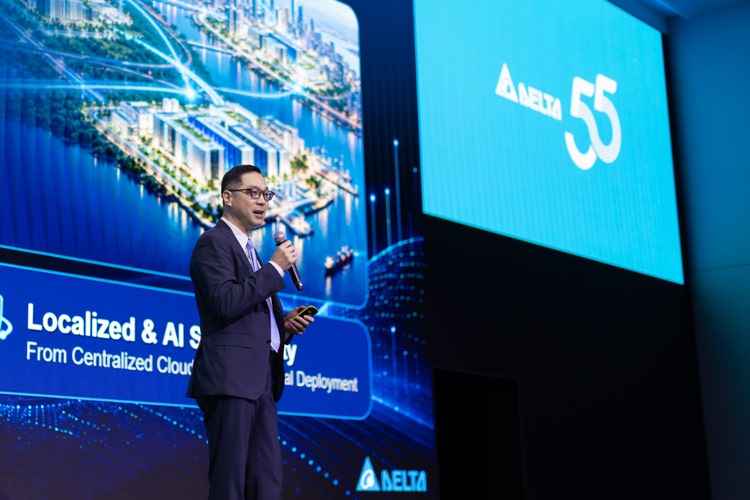
Delta Electronics is a Taiwan-headquartered power and thermal management specialist that has become increasingly important to Asia’s fast-growing data center industry, particularly as AI infrastructure drives higher power densities and greater cooling requirements.
Its data centre portfolio spans UPS and power distribution, liquid cooling, energy storage, modular and containerised facilities, and broader infrastructure management, positioning Delta as an infrastructure supplier to cloud providers and enterprises rather than a data center operator.
In Southeast Asia, Delta Electronics has been pushing further into AI-ready infrastructure. At Data Center World Asia 2026 in Singapore, it unveiled an AI Modular Data Center incorporating 800 VDC power and liquid cooling for NVIDIA Vera Rubin-based systems, alongside microgrid technologies designed to improve energy resilience and efficiency. Its containerised systems can support up to 60 kW per rack, illustrating how Delta is targeting the high-density AI workloads increasingly shaping data center investment across Asia.
At the Delta SEAO Future Industry Summit 2026 in Singapore recently, the technology provider also deepened its collaboration with the National University of Singapore (NUS) College of Design and Engineering (CDE) by joining the Sustainable Tropical Data Center Testbed (STDCT) Phase 2.0 Consortium to foster sustainable AI data center innovation.
“Four out of the ten largest data center capacities to be built in the world are in Southeast Asia and Australia. Also, one-third of the capital expenditure on AI hardware supply chain is going to be invested in Southeast Asia. When’s the last time that Southeast Asia is sitting in the center of things?” Jason Yuan, President, Southeast Asia & ANZ, Delta Electronics said in an interview with CRN Asia recently.
“The era of AI is a maybe once-in-a-lifetime thing, and Southeast Asia plus Australia is sitting in the center of that golden cross. That's where we are super excited, no matter from a company perspective or a regional perspective,” Yuan added.
According to Yuan, Delta currently sits in a very good position in this paradigm shift and is able to contribute to the power, automation and sustainability requirements in this AI era.
"We’re always looking at it from both the business side as well as the sustainability side — those two circles come together, and I think as a company we believe there’s a very big place for us to contribute on both sides for enabling this AI era and the transformation of this digital and AI era for this region,” he said.
The AI hardware supply chain
For Yuan, with so many data centers being built over the next five years, they need to have the compute and all the components that make the data center work. He explained that Delta has the proximity of producing the AI hardware servers to put into the AI data centers or the AI factories that's being built.
“The critical factor for enabling the growth is the power supply, the power conversion efficiency, and the scalability. That's the three things we think across the board is the critical factor. So then if we look at into that value chain, it's not just one single component or one single solution that will make the difference. It's the entire value chain and we keep using the term called grid-to-chip,” he said.
What he means by grid-to-chip is the energy from the grid to the wrench to the greyspace and in the white space and in the rack on the server, on the board and on the chip.
“What Delta offers, is that not only are we good at one component in that critical value chain integration, but we also provide the end-to-end solutions through that value chain. So, on the microgrid side, we provide microgrid solutions. We provide BESS. We are the pioneer in Asia for SOFC. And then moving into the grey space, we provide prefab, PTU, CTU, or the future 800-volt DC architecture in terms of the solid-state transformer, that's power conversion and all the way into the data hall on the rack level of power and cooling technology,” Yuan explained.
“I think that's where we have a huge differentiation where the power efficiency and conversion is about the efficiency on each of the conversions. We can actually shorten that, those conversions, and also make each conversion more effective. We are able to do both. If you look at it in the market, who actually have that grid-to-chip? I'm not sure if any other company can say they have grid-to-chip,” he added.
Meanwhile, Sakda Sae-Ueng, SEA & Oceania Data Center Business Platform Head also shared that when AI companies release new GPUs to market, they have to look at who can power the chip.
“Delta is the one to power the chip. We do a lot of those, the onboard conversion and we're also doing the cold plate whereby we cool and power the chip. And then we move to the racks. We also power the rack with a lot of power shelf for the rack and manifold. We do all systems. And then we are also the one who works very closely with those GPU on one side. And then as a region, we also work very closely with the clients,” he said.
Sakda also pointed out that Delta is focused on enabling these customers to meet the requirements from the GPU. He said that there are a lot of solutions that Delta needs to anticipate, verify and help them to not to do something over-designed.
“We have a flexible solution to you for wave one, wave two, wave three as well. So not as specific products, but we look at how we can have the solution to enable them in order to meet them,” he added.
Managing the supply chain
When it comes to managing the supply chain, Yuan pointed out that Delta's strength and DNA lies in its strong supply chain and manufacturing capabilities.
“When the company was founded decades ago, we started as an ODM provider for power, for thermal, for automation-related products. So, if we are an ODM company, the supply chain and the manufacturers are actually the core strength of a company. I think that's where Delta is making a huge difference,” he said.
For Yuan, some of the current companies that are providing similar solutions may be stronger in sales and in marketing. However, for Delta, he believes the strength is about managing the supply chain as well as production.
“Having said that, I think right now the supply chain is a pervasive for all the players. So having an early line of sight in terms of the opportunity, it's our strength. We work with all these large customers, not only opportunity by opportunity basis. We work as a partner, looking to the next several years of technology, of business roadmap, so that we can plan our supply chain ahead. I think that early line of sight, close partnership with our customers, with our partners, as well as with our vendors are super important,” he said.
Echoing his views is Sakda who pointed out that since Delta’s products have been designed, they have already addressed the supply chain, and the company would never use a single source component.
Microgrid for power management
With supply chain management a strength of Delta, Yuan also believes that when it comes to power management for the data center capacity in the region would benefit a lot from the microgrid.
Also, with data center in the region expected to need around 9% of the total power consumption globally by 2031, the power availability will be a key constraint.
“It's not only about the power generation, it's also the grid effectiveness to where the data center is, the distribution line, and the location of the data center that is becoming a complicated and sensitive issue. So, there's so many things that need to be put into consideration. And most of the time, those places that are having the data centers built, are facing challenge gaining acceptance from the community, especially on water and power, whether the distribution and networking is available to the time that the market would like to have. We see huge constraints on that,” he said.
As such, he sees the microgrid as essential for supporting data centers. Yuan also shared that there are customers in the region that Delta has had conversations with that are already looking to microgrids as an alternative to energy supply and management.