Google to invest US$15 billion in Malaysia as first data center campus goes live
Google’s US$15 billion Malaysia investment over 2027 and 2028 comes with new data center campuses in Selangor and Negeri Sembilan, more than 1GW of new clean energy capacity and skills programs for about 800,000 people.
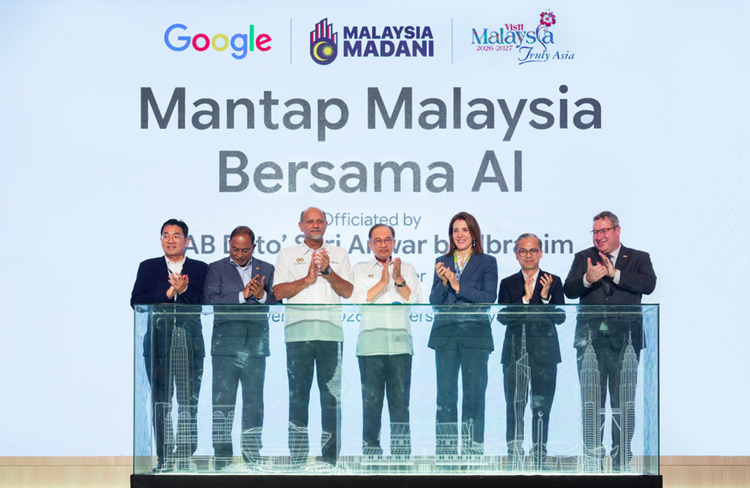
Google will invest US$15 billion in Malaysia over 2027 and 2028, expanding its data center footprint in the country alongside commitments on jobs, skills, water and clean energy.
Ruth Porat, President and Chief Investment Officer of Alphabet and Google, announced the investment on Wednesday (4 November) at Universiti Malaya in Kuala Lumpur, in the presence of Prime Minister Anwar Ibrahim.
The new commitment builds on Google’s 2024 announcement of a US$2 billion investment in its first Malaysian data center and Google Cloud region. Porat, who joined Anwar to break ground on that first campus at Elmina Business Park in Selangor, said the site is now running.
“Today I’m so pleased to say that the campus is fully operational. It’s running 24 hours a day, every day,” she said.
Google said new campuses are planned in Selangor and Negeri Sembilan, and that its computing capacity in Selangor will support its upcoming Google Cloud region in Malaysia.
What the Google Malaysia investment means for jobs and suppliers
Google expects construction of the new campuses to contribute an annual average of US$1.1 billion to Malaysia’s GDP and to support more than 37,000 local jobs a year in 2027 and 2028, about 6,000 of them in construction. Once operational, the facilities are projected to sustain more than 9,000 local jobs a year, with wages averaging 45% above the national median. Those estimates include supplier roles and jobs in the wider economy, not only on-site staff.
Porat said Google was “proud to be creating jobs and even more so to be creating high-value jobs that propel households forward.”
The company said it is working with more than 80 Malaysian entities to build and run its infrastructure. They span construction and civil engineering, network infrastructure, power and cooling components, and services such as logistics.
In his keynote address, Anwar said Google had partnered with local firms “not out of obligation, but because Malaysian companies are competent, disciplined and competitive on world-class terms.”
He called foreign direct investment indispensable and said the higher-paying roles were what mattered. “We do not measure success by headlines alone, but by whether our brightest young talents can earn what they truly deserve and walk with their heads held high on the global stage,” he said.
Google also announced four programs aimed at upskilling about 800,000 Malaysians by 2031. They include Data Center Institutes at polytechnics to train vocational jobseekers for on-site roles.
Power and water
Google plans to bring more than 1GW of new clean energy capacity to Malaysia’s National Grid, anchored by a collaboration with Tenaga Nasional Berhad (TNB) under the Corporate Renewable Energy Supply Scheme. Porat said the partnership will also explore round-the-clock clean energy projects “to ensure reliable power even when the sun isn’t shining.”
Google said it will pay for all the electricity its campuses use, as well as the direct infrastructure costs of connecting them to the grid.
“Google is not competing with our households for electricity,” Anwar said, adding that the company was paying fully for its own power without public subsidies.
The company said its custom-designed equipment allows it to run campuses in tropical climates such as Malaysia’s at a power usage effectiveness (PUE) of 1.12 to 1.14, against an industry average of 1.54. PUE compares a facility’s total energy use with the energy used by its computing equipment, so a figure closer to 1.0 means less power is going to cooling and other overheads.
On water, Anwar said Google had committed to giving back more fresh water to Malaysia’s watersheds than its operations consume. He said the off-river storage reservoir and treatment plant Google is developing is designed to deliver 65 million litres of potable water a day, and that ownership would be handed to the state government on completion as a permanent public asset. Google has said the project is in Negeri Sembilan.