Teradata, Dell and NEXTDC sign sovereign AI MoU in Malaysia
The three companies will offer an integrated sovereign AI stack at NEXTDC’s KL1 data centre, with Teradata targeting banks and the public sector first.
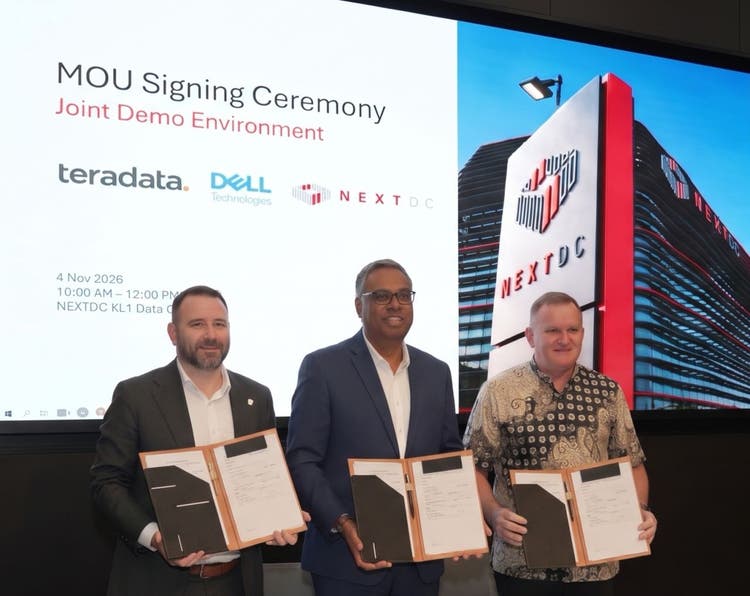
Teradata, Dell Technologies and NEXTDC have signed a memorandum of understanding (MoU) to set up a joint sovereign AI environment for Malaysian enterprises at NEXTDC’s KL1 data centre in Petaling Jaya.
Under the MoU, signed on 4 November, Dell’s GPU servers and storage and Teradata’s data and agentic AI software will be housed at KL1 as a single integrated stack. NEXTDC is supplying a facility built for high-density, GPU-intensive workloads, while Teradata’s software layer handles data management and governance, along with agentic AI tools that run directly on enterprise data.
The companies said the aim is to help Malaysian enterprises move AI projects from proof of concept into production, naming financial services, telecommunications, government and manufacturing as target sectors.
Josh Abbott, Teradata’s vice president for Asia Pacific and Japan, described the agreement in a media Q&A after the signing as “a commitment to sovereign AI.”
Sovereign AI stack runs on Dell hardware
Abbott said customers would buy all their hardware through Dell, which partners with Nvidia for GPUs, with the cost passing through to the customer.
“In the Teradata Factory stack, it’ll be all Dell hardware and it’ll be in partnership with Nvidia,” he said.
Teradata Factory, which Teradata unveiled in May, packages its software with Dell compute and storage for on-premises deployment.
Abbott said compliance with US export rules on GPUs would also rest with Dell, which runs much of its Asia Pacific and Japan manufacturing in Malaysia; Teradata has not manufactured its own hardware since 2012. He said he had not run into any problems on that front so far, adding that it was still early days for this business in Malaysia.
No KL1 capacity has been set aside for the collaboration yet. “We don’t have anything predetermined right now in that regard,” Abbott said.
Banks lead the pipeline
Teradata’s initial targets are financial services and the public sector, which Abbott attributed to their regulatory requirements and low tolerance for error. He could not name any customers.
“Right now in our pipeline, the banks are where we’ve got the most traction,” he said.
Sumash Singh, Dell Technologies’ managing director for South Asia and Emerging Markets, said in his address at the MoU signing that enterprises’ main challenge now was making sure AI delivered tangible business benefits, with access to the technology no longer the main hurdle. He cited Dell research showing that poorly integrated infrastructure still holds companies back from deploying AI more widely.
Luke Mackinnon, NEXTDC’s senior vice president and managing director for Asia, said in his address that KL1, which opened in May, is being built in phases towards 65MW of total capacity by 2028. The facility holds Uptime Institute Tier IV certification for its design and construction, and operational certification is still in progress.