One-third of enterprise data remains dark, hindering AI success: Everpure
For Everpure, rather than viewing dark data solely as a liability, organizations should actively map their data across two dimensions – business value and risk.
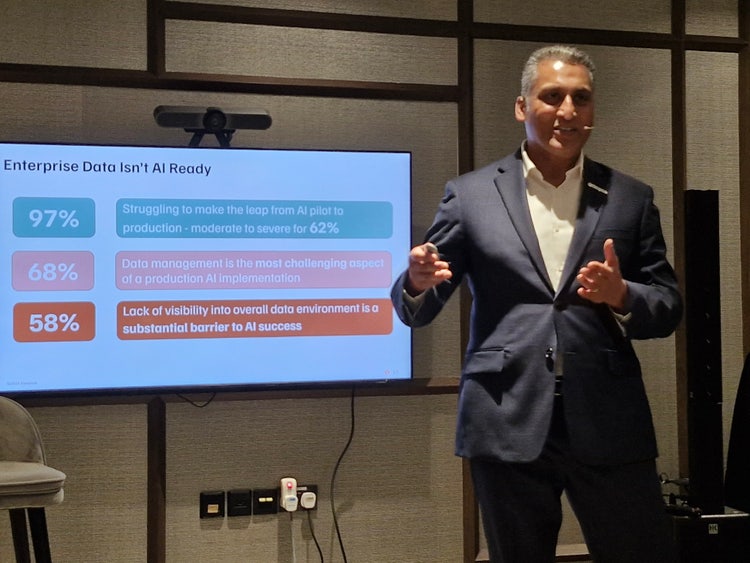
As data management continues to be a top business priority as organizations seek to ensure their data is visible, governed, trusted, and ready to power AI, findings from an Everpure report with Omdia revealed that dark data continues to hold organizations back.
According to the study, 99% of organizations have dark data, with over half (51-75%) reporting that it accounts for over one-third (37%) of all their enterprise data. The inability to separate and leverage high value data contributes to significant issues such as substantial financial waste, potential compliance or security vulnerabilities, and missed opportunities to drive insight and innovation.
The study also revealed that a staggering 97% of organizations are struggling to transition from AI pilot to production, with 62% facing moderate-to-severe obstacles. 68% of IT leaders rank data management as the top challenge when moving AI into production while 63% cite storage silos and data sprawl as significant barriers to AI success.
For Everpure, rather than viewing dark data solely as a liability, organizations should actively map their data across two dimensions – business value and risk – to decide what to activate, govern, retain, or delete. This is an ongoing process requiring regular adjustment, not one-time exercise.
This is where data governance and data sovereignty come into play as well. Everpure recommends the following framework to help organizations assess and remediate their data profiles:
- High Value, High Risk: Activate sensitive data only under strict governance, rigorous access controls, and robust security.
- High Value, Low Risk: Prioritize for immediate discovery and activation to quickly fuel AI initiatives.
- Low Value, High Risk: Secure, minimize, or permanently delete to reduce liability and compliance exposure.
- Low Value, Low Risk: Archive or delete to cut storage costs and curb data sprawl.
Looking at data governance tools, Ashish Gupta, General Manager, Data Management, Everpure, highlighted that conversations with some customers have revealed that their data governance tools don't have the ability to automatically populated.
“It's mostly humans in the back that are saying, this data is important, forensically this data is used more by a SQL query and this is not used by a SQL query, therefore it must be okay. And that takes data governance a long time to get implemented,” he said.
Citing an insurance company customer example in the US that uses Everpure’s product with a data governance and cataloging company, Gupta said the company was able to take information output from the Everpure platform which gave them actual insights about why this data entity is important and how it is related to the business process and to other data entities.
“The difference really comes down to the context. The second thing it comes down to is the need to be able to access any kind of data. Most data governance tools will either be good on cloud, maybe some on structured, some on unstructured, only on cloud. You need to have a very good understanding, and it needs to be a continuous understanding of discovering your data and classifying it on an ongoing basis. And that's what we've seen are the two big challenges that we address for our customers that have been using data governance and cataloguing tools but haven't made the progress until we were able to populate those tools with this kind of context,” Gupta explained.
Meanwhile, Nathan Hall, VP & GM, APJ, Everpure pointed out that data sovereignty isn't just about compliance to a government.
“If you don't know where your data is and where it's coming from, there could be things that are outside of specific governmental jurisdiction issues. But they still impact, essentially, your value chain. So, it's not just going to be a governmental thing. It's going to be around, especially as macroeconomic, geopolitical change happens so quickly, customers, companies need to understand where their data is, who has control over it, from both a government perspective and just a supply chain, because the data is the lifeblood of the business,” he explained.
Hall explained that Everpure is developing or deploying on-prem AI at scale for thousands of users and they have been very partial to sovereignty and that force of policies.
“Our real driver behind the scenes is productivity. We believe by putting the AI closer to our users and our data, we can increase productivity dramatically. And our data so far seems to support it. It seems like we are much faster coming around. So, sovereignty, interestingly enough, for us, at least, is hand-in-hand with efficiency,” he added.
Everpure continues to record strong growth in Singapore and the rest of the Asia Pacific region as the storage and data management vendor looks to meet the growing demand for its products in the region. With a revenue growth of 38% YoY and operating profit growth of 77% YoY in Q2 globally, the vendor also recorded 34% external OEM storage market YoY growth in the region, with a 224% All Flash external OEM Storage Market YoY growth in Singapore.