Five key takeaways from distributors at GTDC Summit APJ
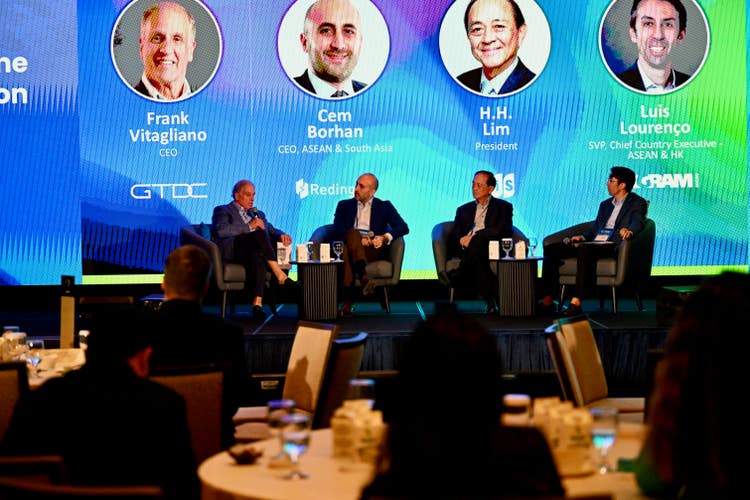
Cem Borhan, Chief Executive Officer, ASEAN & South Asia, Redington Limited, H.H. Lim, President at SiS and Luis Lourenço, SVP &CEO ASEAN & HK at Ingram Micro discuss the key issues for distributors in a panel moderated by Frank Vitagliano, CEO of GTDC.
With AI remaining a key focus area for organizations in 2027, distributors are also having to evolve and adopt to meet the requirements of customers. In the APAC region, more distributors are evolving their models with many co-investing and co-innovating AI products for customers.
There is also the rise of the Frontier distributor, which is capable of delivering a more focused and comprehensive offering to customers on AI. The distributor ecosystem remains committed to becoming ecosystem orchestrators in bridging the link between technology, customers and vendors.
During a panel discussion with three distributors at the GTDC Summit APJ 2026, Frank Vitagliano, CEO of GTDC believes that distributors in the region are well informed and know what’s going on in the ecosystem.
“They're making the steps necessary to make sure they provide value to the rest of the constituents in the ecosystem, which is primarily the vendor community, who are also like partners and customers,” he said.
The panelist featured Cem Borhan, Chief Executive Officer, ASEAN & South Asia, Redington Limited, H.H. Lim, President at SiS and Luis Lourenço, SVP &CEO ASEAN & HK at Ingram Micro.
Here are five key takeaways from the panel discussion.
APAC is a huge market for distributors
According to Lim, there continues to be a huge opportunity for distributors in the region simply because the market represents 59% of the world population with a US$110 trillion GDP. However, Lim believes that distributors cannot treat Asia as a single market because each country has its own characteristics.
“It has got its own different level of IT maturity, different channel structure. So, at SIS, we believe that you need to have the central regional focus, and the local execution is the far most important element for success. For SIS’ strategy and priority in the Asia market, I would say that ASEAN is still by far the most promising market for us,” he said.
With Vietnam and Indonesia seen as less mature markets offering tremendous opportunities, Lim also pointed out that there remain opportunities in mature markets like Singapore, Malayia and Thailand as well.
“We never treat ASEAN or Asia as a single market. Each country needs their local focus, local execution, local team in order to be successful in this distribution business. The good news is the opportunity is across the entire region, which is a good place to be honestly. And hopefully, it will continue for a period of time,” he said.
AI capabilities vs AI readiness
For Borhan, there needs to be a distinction between AI awareness and AI capabilities versus AI readiness.
“Everybody has interest and awareness. But what about readiness? What about the capabilities of those partners, and how are we going to be supporting them? I think that is the big question that we have. So, as distribution, of course, we need to support that. So, at Reddington, we're putting a 3P approach which is the sense that one is the problem, second one is the proof that we are putting in, and the third one is the people.”
“So, when we go around that, we're trying to support this with our assets, starting with the problem part. So, what is the problem that the customers are facing and the customer problem that we need to be addressing. We are trying to put it in so that the customer outputs are there, so that we address those problems, and we can showcase those problems.”
“The second one is the area in which we are showing proof. In order to achieve that proof, we are putting in place our COE environment, or we call it the launchpad environment, because in the AI age, we have to put it in a launchpad manner so that these partners are coming to our launchpad and experiencing what kind of solutions they could be providing to them. And the third is the people is the training part,” he said.
Borhan explained that when all these three add up, partners have a guide on the AI journey, which is the approach that Redington is taking.
Leveraging the platform
The platform is expected to remain in choice when it comes to organizations looking to consolidate or have better management of their tech investments.
Interestingly, Lourenco pointed out that the while the platform is the way forward, it's also a continuous journey where many are not sure where it ends.
“This journey that we are going through in the last couple of years started first with digitalizing our business. With that said, we have managed to connect thousands of vendors with hundreds of thousands of partners. And with that, we can offer hardware, software services and multi clouds that we were not capable of from a distribution standpoint to offer before,” he explained.
At the same time, Lourenco pointed out that the platform journey generates transactions and interactions that have a lot of data behind and the strength of it.
“Where you start to capitalize, it is when you pick up the data. You transform it in intelligence and then you create opportunities. Now we bring the genetic era to it. And that is really impressive. I'm having a challenge to keep up to the pace of so much innovation of what all of us are doing. You really need to go fast,” he said.
For Lourenco, distributors should also leverage the platform. Sharing some examples of how Ingram Micro is using its platform, Lourence said that Ingram has picked up data management for some services and have enabled partners to have access to be capable of seeing insights of their customers.
“We are now focusing on starting to create the demand generation for the partner ecosystem to be capable of getting their customer base, to generate demand of what they are not selling. Because when we see what they are selling, we can cross sell what they are not selling and ultimately create initiatives to do so,” he said.
He also pointed out that Ingram is also looking to leverage the platform for training and enablement. This includes bringing content and enabling teams across the region.
“At the end of the day, we are capable of becoming an orchestrator of multiple technologies and solutions. That is the objective of what the partners and what the vendor ecosystem wants from us,” he added.
Security at the core
Looking at cybersecurity opportunities for distributors, Lim pointed out that the introduction and deployment of AI agents are also being leveraged by hackers who are finding ways to use it to their gain.
“AI governance is one critical element in order to prevent data breaches and AI related cyberattacks in the future. AI governance is very crucial, I would say. Before any organization deploys AI solutions, they have to look after the governance aspect. So, you need to decide what is allowed, what is not allowed, and then set up benchmarks in order to monitor governance issues,” Lim said.
“As a distributor, our job is to help the reseller to be equipped with sufficient knowledge, sufficient expertise in order to go to the market and sell to SMBs. The big enterprises have got all the resources which we do not have to worry about. But the SME who are mainly buying from the smaller reseller, these are the sector that we see that has got the most critical need for education, for enablement,” he said.
For Lim, this is the opportunity for a distributor to drill in and to address the issue, which all parties can benefit from.
Distribution in 2027
For Lim, looking into 2027, the technology distribution business has evolved so much over the few decades, with the computing scenario evolving from distributed computing into cloud, virtualization, and so forth.
“So, the distribution model has also changed and has evolved. Now, no matter what a distributor does in this evolving technology industry, one important thing is that as a distributor, you always have to look at the value you are creating for vendors and customers. Now, this is very critical. If a distributor is not able to create value, then you become irrelevant,” he said.
Borhan shared that when it comes to 2027, Redington is already investing heavily AI but he believes the challenge for all distributors is not going to be on where the outcomes are but how can distributors create the competencies that will be the important area for next year.
“That is an important part. The second is the supply and demand issues, which is also increasing pricing. It has its good part, which is the average selling price is going down, which is good for all of us. But on the other side of it, it also puts extra pressure to us because of the margin, especially for the emerging markets that are being challenged on that matter,” said.
Meanwhile, Lourenco foresees that 2027 is probably going to be more accelerated and more challenging, especially with the geopolitical scenario and the policies that come from it.
“I think these things are not going to become easier. They are going to become more challenging. There are going to be supply chain challenges which could take another two years to get better because at the end of the day, manufacturing is a limitation. Labor is also going to be a challenge because tech talent is limited,” he said.
For Lourenco, as technology is being embedded with AI in every single industry, distributors are no longer competing among themselves as there is a trillion-dollar industry opportunity.