Cisco brings Anthropic’s Claude Mythos into AI Defense to strengthen AI red teaming
Anthropic’s Claude Mythos will augment the AI Defense framework with advanced reasoning that plans tests that matter and translates the results into attack ideas for each system.
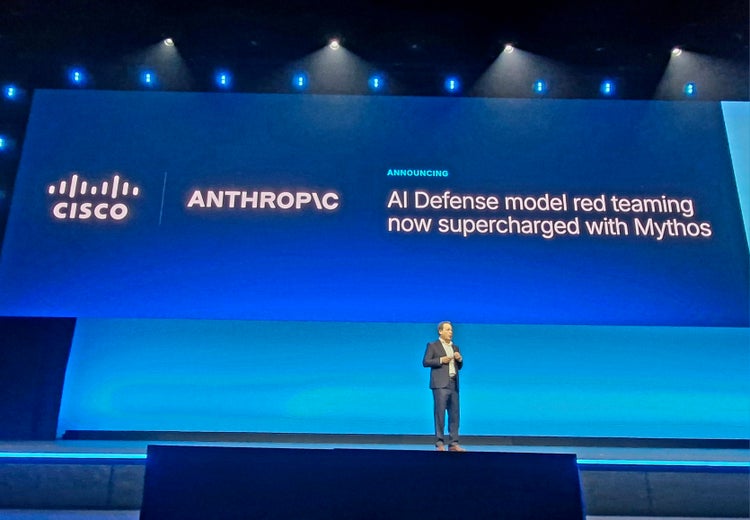
Cisco is adding Claude Mythos to AI Defense for red teaming AI applications and agents, empowering defenders to stress-test AI systems with frontier adversary reasoning.
Making the announcement at Cisco Live APJC in Melbourne, Australia, Jeff Schultz, SVP, Portfolio Strategy and Marketing at Cisco said that the partnership with Anthropic and Cisco does not mean that they are exposing Mythos to customers but instead will be using Mythos internally as part of AI Defense to strengthen and enhance its capabilities to understand the attack vectors that customers are concerned about.
This includes having Claude Mythos augment the AI Defense framework with advanced reasoning that plans tests that matter and translates the results into attack ideas for each system.
During a media briefing session, Natalie Mead, Head of Applied AI for APAC at Anthropic shared that the partnership does not mean that customers will get access to Mythos server. Instead, it will be a very specific test that customers can run with Cisco on AI Defense.
“What’s exciting is the red teaming whereby the Cisco team will help us take action on this. A lot of what we’re seeing with Mythos customers is that we’ve shown them these vulnerabilities and talked about what to do next. But this can be daunting for CISOs. When you see how many vulnerabilities you might have at your own site, you then have to think about what to do next? “
“And so having the Cisco Red Team available to actually action and take that barrier of moving on and getting into the details is really critical. And that's why we're so excited to have you guys really think about that partnership,” Mead said.
Addressing the attendees at the summit, Mead also shared that the exciting thing with Mythos and AI Defense is just built to date AI Defense.
“You use our models, we look at the plan, and we try to figure out creative ways that we can attack vulnerabilities and bugs and really give a solution that's just already built into AI defense. It's really exciting because in reality, a customer doesn't have to think about all these different Mythos. It's just taking that and then moving forward and red teaming for you, which is super exciting,” she said.
One customer that is already using this is NEC Corportaion. During the keynote session as Cisco Live APJC, ITO TAKESHI, Executive Professional, Data & Analytics Division, NEC Corporation shared that the partnership is a really critical and big strategy for the company.
“NEC has been using Frontier AI for frontier detection. Now, this new feature is taking us to the next level and addressing our big challenges. NEC is using gradually the expanded AI Defense to secure our internal AI application. We are using, testing, then translating such kind of know-how to the customer facing the challenges. We are then enhancing that enterprise solution of the AI system assessment. Together with Cisco and Anthropic, it's really a big strategy for this challenge,” he shared on stage.
Splunk Agency Observability
Apart from the availability of Claude Mythos on AI Defense, Splunk by Cisco also unveiled new Splunk Agent Observability innovations which will bring agent cost and quality into one unified view.
The Splunk Agent Observability’s enhanced Tokenomics capability will provide comprehensive cost governance that ties AI spend to output quality, giving organizations running on Amazon Web Services (AWS) a unified way to monitor each agent by its cost and business results.
In a blog post, Kamal Hathi, SVP and GM of Splunk by Cisco shared that Tokenomics pairs the cost of every agent with evaluations that grade the quality and impact of the work, giving organizations a single view of AI ROI. Hathi stated that the solution leverages usage data from Amazon Bedrock and Amazon CloudWatch, then combines those technical metrics with customer-defined business KPIs like NPS (Net Promoter Score) or cost-per-claim to produce ROI reports executives can act on.