‘The most challenging certification’: Inside ECCOM’s Cisco 360 transformation journey
“The certification is a very high standard for the partner. It's a challenge and I think it's maybe the most challenging certification for partners,” says Li Zhong, Senior Vice President, Product, Technology & Services, ECCOM.
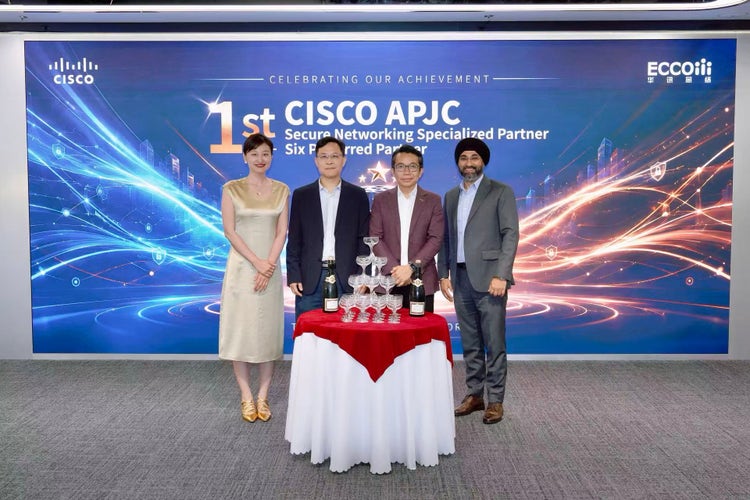
When Cisco’s revamp partner program went live earlier this year, many partners in the Asia Pacific region knew that this was an opportunity for them to build their capabilities as they look to reach out to more customers in their respective markets.
Cisco 360 represents the biggest overhaul of Cisco’s partner program in nearly 25 years, shifting the focus from transactions and product volume to partner value, expertise and lifecycle outcomes in the AI era.
The biggest structural change is the introduction of the Partner Value Index (PVI). Instead of relying primarily on traditional tier requirements and sales metrics, Cisco now measures partners across key technology portfolios including security, networking, collaboration, services, cloud and AI infrastructure. The goal is to recognize both broad platform partners and deep specialists.
These changes also meant that Cisco partners around the world would now need to meet the requirements to become a Cisco Preferred Partner – the highest tier in the new program.
In the APJC region, ECCOM became the first partner in the region to achieve all six specializations required into the new program and achieve the Cisco Preferred Partner status.
In a conversation with CRN Asia, Li Zhong, Senior Vice President, Product, Technology & Services, ECCOM shared that the China-headquartered systems integrator and digital transformation company has had a relationship with Cisco spanning over three decades, starting with the networking business and moving into AI today.
“When Cisco 360 was launched, the changes are successful because customers are now paying attention to the business outcome. When a customer wants to do something, they look to several partners or vendors to provide services or technology for them and their standards are high. Looking at customer’s needs, especially with more devices connected to the network, they no longer just need a single point of, for example, security access. They need end-to-end platform capabilities and build across the networking, the security operations, and identity authorization, and so on,” he said.
Achieving certification
“So, we rebuilt our own properties and organizations around the needs of the customers' business. The transformation is driven not by us. We are following the market and the customers' needs. I think we are in the direction of the transformation for our customers' needs,” Li explained.
Li also shared that achieving the certification was no easy task with the team of 40 to 50 engineers spending almost 2,000 hours working and preparing almost 2,000 documents for the certifications.
“But we think all the investment is very valuable, because we just think the certification is just not to get a certificate. It's a learning journey for us. Firstly, we revised or we made our offering more useful for our customers. We no longer just package the products. We package the solutions that combine the multiple activities, along with the industrial scenario and the customer business value,” Li said.
Li also pointed out that the go-to market material is very important.
“Our system can use the go-to-market material to move from selling deals to selling business outcomes. Third, was how we can manage our lease or manage our pipeline from the whole lifecycle from the opportunity to close the deal. We redesigned every step so we can analyze the customer more efficiently and the potential business opportunity and the effective drive the conversation and the deal close. Fourth, its about how we can provide the service delivery and the customer success, which is also very important,” Li added.
For Li, it has been a very enjoyable learning journey with Cisco to achieve the status.
“Every offering we made as a platform, we developed parts, material we made as a documentation. I think it's very useful and valuable for us. The certification is a very high standard for the partner. It's a challenge and I think it's maybe the most challenging certification for partners,” he said.
A partnership journey
For Ashley Zhou, Director and General Manager, Greater China Partner Sales at Cisco, the partnership journey between Cisco and ECCOM can be summarized as customer obsession.
“We're always focusing on market transformation and customer needs. So how to build up an ecosystem with ECCOM to better meet what customers are looking for, from the cutting edge technology, to the quick and reliable services and smooth lifecycle management,” she said.
Zhou pointed out that the journey with customers has evolved from networking to AI security with huge market opportunities in the region.
“Based on current, the customer needs and the market opportunities, there is no one vendor that can provide holistic end-to-end solutions to the customers, especially in the AI era. So that's why we really value the cooperation with ECCOM, because from ECCOM's perspective, they are not only the biggest vendor for Cisco, but they're also the biggest vendor for a networking and domestic vendors, technology providers in China,” she explained.
“From ECCOM’s perspective, they're not only reselling the solutions and products from the vendors, but for themselves, they have a very strong capabilities for their R&D, their software development, their AI agent management, and their platform, their manual service, and more. So, ECCOM is our biggest and the most important partner to coordinate and combine all the solutions from different vendors, and plus their own capabilities to package the overall end-to-end solutions to our end-user to help them to accelerate their AI transformation,” she added.
For Zhou, this is why cooperation and partner strategy are super important.
“It's definitely not easy and we really much appreciate all the efforts ECCOM put into this journey. I would call it a transformation journey, like Cisco and our partners evolving together to achieve more customer value,” Zhou said.
From Cisco's perspective, Zhou pointed out that the overall Cisco 360 program is designed to enable, support, and recognize partners who invest in capability and customer value.
“This means when the partner delivers the high value solutions and the services that make a real difference for customers, the partner won't only win the customer's trust, they will also get more support and more investment from Cisco. ECCOM is definitely the example of partner who learn in early in this stage. It's all about helping partners like ECCOM to build a sustainable and differentiated business to create more value to our customers,” she added.
“I'm really happy that ECCOM from mainland China, a country which doesn't speak English as a first language, was able to achieve this first secure networking specialization. This also demonstrates the strong capabilities of ECCOM from the partner perspective,” Zhou said.
Growth in China
Given the success of ECCOM in China, Zhou shared that Cisco currently has more than 2,500 active partners have business transactions with Cisco. Under the Cisco 360 mechanism, the vendor currently has more than 300 partners, which only 12% the overall active partners contributing to 85% of the overall business in China.
“This means our business tends to be more conducted by high value partners. I think from a secure networking perspective, it's definitely the direction and marketing demand from our customer perspective. And with ECCOM's best practice, it definitely motivates and stimulates the intention of our other partners to get this certificate as soon as possible,” Zhou said.
Zhou also highlighted that partners on the certification journey will not only get the most secure investment from Cisco but also be able to deliver more high value solutions to customers.
From the Cisco 360 perspective, Zhou also mentioned that besides the secure networking specialization, Cisco already has three partners who have six preferred certificates. This means that their capability is not only focused on one area like networking, but have every kind of capabilities from networking, security, AI, observability, services, and more to deliver the holistic solutions and to better fulfil customer demand, especially in the AI area.
“So, I definitely believe that we will have more partners get this certificate and also to deliver more value to our customers. They are still on the learning journey. To acquire this certificate, from Cisco's perspective, we would not only measure and assess the Cisco performance, only from the booking perspective, we will value and evaluate our partner capability from our end user, the real business case, the selling scenario, the transformation capability, etc.
“So that's why during the process to acquire this certificate, they need to prepare a lot of real cases and their abilities, etc. But it definitely will help our partners to better understand what the priority would be, the demand from our customer perspective, and in which industry to focus on,” she added.
Acknowledging that the journey is challenging, Zhou also feels that with Cisco and the partners working together, they will learn a lot and will definitely accelerate the business outcome based on the capability they gain from this journey.
Opportunity for partners
While Li thanked the Cisco teams for achieving the success, he reiterated that the entire journey was such a challenging task.
“We get a lot of support and help from Cisco. At first, we had no idea how to make the offering as the business offering is very complicated. Cisco helped us to do some workshops on offering design and go-to-market material and the methodology. I think it's very important because we are not so familiar with such areas. The second is that I think we are training on our process methodology. Cisco pays more attention to the customer success and how we can meet our customers. The business outcome is the most important for our customers,” he said.
Li believes that the process methodology helped them to pay more attention to the business outcome, but not just the product or the technology. He also felt that the Cisco technician team helped them do more practice on the demo, especially in setting up the demo environment.
“We can prove that we have such capability. We can help our customers implement or design. So, I think from the Cisco side, help is very important. My advice is if another partner wants to make it, or they want to get it done, the first thing they should do is to look for Cisco for the long-term partnership. I think it should be to invest or to be patient, or to be persistent. Because I think the entire transmission journey will definitely be full of difficulties. They should not retreat or pull back when they meet difficulties,” he concluded.